I wrote a fic recently and the word count for the first
draft came to about 40,000 words – roughly the length of a novella or ficlet.
And that’s fine because I wasn’t striving for a novel or a 100K slow-burn coffee shop AU.
But coming to edit my first draft I realised something about
myself. I am an underwriter. My fic
could actually be at least 10k (maybe 20k) longer. Of course it’s not all about word count, it’s about the story,
but in this case a smaller word count isn’t because I’m a fantastically efficient storyteller it’s
because I’ve missed out a lot of stuff. Like, Important Stuff.
So as I set out to add muscle to the skin and bones I’ve
already created in draft one I thought I’d share five tips for my fellowunderwriters
to help you flesh out your writing too.
1) Make sure to describe the place and space in
which the action happens.
There are quite a few places in my first draft where there’s
no indication as to where things are taking place– or there is, but it’s the
bare minimum and not really enough to build up a clear picture.
This probably because as the writer I know exactly what the place looks like so I make the
assumption that a bare minimum description will mean the reader knows too.
Now I’m not saying go into masses of detail about what your
settings look like. In some cases it’s not useful to describe setting in a lot of detail (e.g. during really
fast paced action sequences) but doing a
verbal sketch of the space is essential for putting your characters in context and reader understanding.
I really is a fine balance (which is why beta readers are your friend!) But
definitely go back to your setting descriptions if you’re an
underwriter, they might need some work.
2) Make sure to describe your character’s appearance.
Similar to the above point – you know what your characters look like, but unless you describe them,
the reader won’t.
It’s fair to say that descriptions are open to reader
interpretations, but that doesn’t mean you shouldn’t describe them in a healthy
amount of detail. So you might try to nail down some of the interesting quirks
about your characters to help the reader build a picture – not only will it
help the readers understanding, it’ll boost your word count too!
Note: This one functions a little differently in
a fic because the readers are probably familiar with how the character looks,
but there is nothing wrong with adding your interpretation (or even reminding
them, especially if the characters are from a book.)
3) Include character reactions outside of what they
say out loud.
Real life conversations aren’t just about the stuff that
comes out of our mouths. So much of human interaction is about body language –
so include it in your writing! Saying that the character covers their mouth
with their hand when they talk suggests shyness. While another character crossing
their arms shows they’re defensive -perhaps because they’re feeling threatened.
In real life we don’t always say what we mean – but a lot of the time our actions give away what we’re really thinking. By including these actions around dialogue
writers can influence how we as readers view characters and how we interpret interactions
between characters. And it can boost your word count too.
The big stuff:
4) Check your pacing.
When you write it feels like your scene is taking place over
hours, days, weeks because when you’re writing it takes time. Reading, on the
other hand, is much quicker. A seasoned reader can fly through a 100 page novel
in a few hours – a seasoned writer can spend hours writing a 100 words.
When you read back your writing, make sure to check your
pacing. You might just find that the Impossible Task you set for your
characters at the start of the story is suddenly resolved within the next fifty
pages. To boost your word count you
might want to start by adding more obstacles between the character and their goal.
For example; your character has to find an object such as a
precious jewel. Sounds relatively easy, right? But what if the jewel is lost in
the mines of an ancient people, amongst thousands of other treasures that look
very similar? What if no one has found this jewel because it’s guarded by a
fire breathing dragon? What if the ancient mines and dragon are located in a
mountain which is miles and miles away across dangerous lands? What if your
characters need to enlist the help of someone with a very specific skill set?
You take one simple objective (finding the jewel) and you
put into play a series of obstacles that must be overcome in order to complete
the objective. Your underwriting tendencies, like mine, might just mean that there
aren’t enough metaphorical (or real) dragons in your story!
5) Sub-plots.
A sub-plot is a smaller scale plot – often involving
the supporting characters – which runs secondary to the main plot. It can be
directly linked to the main plot, i.e. the info provided in the subplot
directly influences events in the main plot. Or it can simply be linked through
place, time or themes of the overall story (e.g. Hermione’s elf rights campaign
‘S.P.E.W’ in Harry Potter and the OoTP is linked to the overall theme of
oppression.)
Sub-plots are great because they can serve as some respite
from a traumatic main plot; your character is fighting a war (main plot) but
also fighting and failing (in hilarious ways) to win the affection of their love
interest (sub-plot).
Plus, sub-plots can also help with characterisation, can
cause your main character to have the moment of realisation which allows them
to overcome the obstacles they face in the main plot and is generally a better
reflection of real life! Sub-plots often centre on side-kicks and other
characters – people who might not be as devoted to the end goal as the
protagonist is. In fact, well written
side characters seemingly live their own lives with their own goals. You might choose to showcase
this in your sub-plot by letting the conflict of interest cause more
problems for the protagonist to overcome.
Either way you could find your word count sky rockets as soon
as you add in a few clever sub-plots.
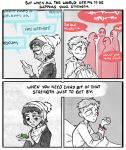
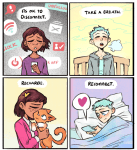
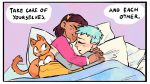
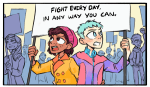
A comic about looking after yourself, your loved ones and your mental health during the tough times ahead. I started this last November, when people were hurting so hard it was difficult to function – I’m sorry it took me so long to finish it.




































 AUTHOR | HISTORIAN | ARTIST