
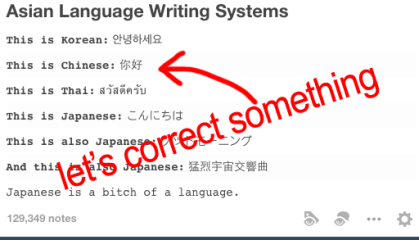
Chinese: (main systems)
pinyin: Zhìshāng gēn dōngtiān hēilóngjiāng de wēndù yīyàng
繁体:智商跟冬天黑龍江的溫度一樣
简体:智商跟冬天黑龙江的温度一样
Chinese characters and derivatives
- Chinese
- Minority languages in China
- Dong
- Bai (obsolete)
- Miao (obsolete)
- Zhuang, with Zhuang logograms
- Japanese (kanji plus kana derivative)
- Korean (hanja) (obsolete; used in academic texts and newspapers)
- Vietnamese (Han-Nom) (used in historic or academic texts, or for artistic or aesthetic purposes, but in general use virtually extinct)
- Extinct languages
- Khitan, written in Khitan scripts
- Jurchen, written in Jurchen script
- Tangut, written in Tangut script
Extra info:
- 象形 xiàngxíng: Pictographs, in which the character is a graphical depiction of the object it denotes. Examples: 人 rén ”person”, 日 rì ”sun”, 木 mù ”tree/wood”.
- 指事 zhǐshì: Indicatives, or ideographs, in which the character represents an abstract notion. Examples: 上 shàng ”up”, 下 xià ”down”, 三 sān ”three”.
- 會意/会意 huìyì: Logical aggregates, in which two or more parts are used for their meaning. This yields a composite meaning, which is then applied to the new character. Example: 東/东 dōng“east”, which represents a sun rising in the trees.
- 形聲/形声 xíngshēng: Phonetic complexes, in which one part—often called the radical—indicates the general semantic category of the character (such as water-related or eye-related), and the other part is another character, used for its phonetic value. Example: 晴 qíng ”clear/fair (weather)”, which is composed of 日 rì ”sun”, and 青 qīng ”blue/green”, which is used for its pronunciation.
- 轉注/转注 zhuǎnzhù: Transference, in which a character, often with a simple, concrete meaning takes on an extended, more abstract meaning. Example: 網/网 wǎng ”net”, which was originally a pictograph depicting a fishing net. Over time, it has taken on an extended meaning, covering any kind of lattice; for instance, it can be used to refer to a computer network.
- 假借 jiǎjiè: Borrowing, in which a character is used, either intentionally or accidentally, for some entirely different purpose. Example: 哥 gē“older brother”, which is written with a character originally meaning “song/sing”, now written 歌 gē. Once, there was no character for “older brother”, so an otherwise unrelated character with the right pronunciation was borrowed for that meaning.
For over two thousand years, the prevailing written standard was a vocabulary and syntax rooted in Chinese as spoken around the time of Confucius (about 500 BC), called Classical Chinese, or 文言文wényánwén.
Modern written Chinese, which replaced Classical Chinese as the written standard as an indirect result of the May Fourth Movement of 1919, is not technically bound to any single dialect; however, it most nearly represents the vocabulary and syntax of Mandarin, by far the most widespread Chinese dialect in terms of both geographical area and number of speakers.[43] This version of written Chinese is called Vernacular Chinese, or 白話/白话 báihuà (literally, “plain speech”).
Cantonese is unique among non-Mandarin regional languages in having a written colloquial standard, used in Hong Kong and overseas, with a large number of unofficial characters for words particular to this dialect.
To a lesser degree Hokkien is used in a similar way in Taiwan and elsewhere, although it lacks the level of standardization seen in Cantonese.
Also ie:
Character: 樹 English meaning : to plant, place uprightModern (Beijing) reading: shùPreclassic Old Chinese: dhoʔClassic Old Chinese: dhóWestern Han Chinese: dhwáEastern Han Chinese: ʒhwáEarly Postclassic Chinese: ʒhwóMiddle Postclassic Chinese: ʒhwóLate Postclassic Chinese: ʒhwóMiddle Chinese: ʒ́ǘDialect:Character: 樹MC description : 遇合三去遇襌ZIHUI: 2885 0898Beijing: ṣu 3Jinan: ṣu 3Xi’an: fu 3Taiyuan: su 3Hankou: śy 3Chengdu: su 3Yangzhou: su 3Suzhou: zü 32Wenzhou: zi_ 32Changsha: śy 31 (lit.); śy 32Shuangfeng: ɣy 32Nanchang: śy 32Meixian: su 3Guangzhou: šy 32Xiamen: su 32; chiu 32Chaozhou: chiu 32Fuzhou: söy 32Shanghai: zü 32Zhongyuan yinyun: šiu 3More?:1 Stylized Mandarin:
This category constitutes the majority of the previous literature. Why it is named “stylized Mandarin” is because these lexical items either did not exist in Mandarin before or have totally different references in Internet language. Most of Gao and Yuan’s lexical examples (2005) fall within this category. Some examples are cited as follows: a) Jiajie 假借 (‘borrowing’) [a], e.g., mao 猫 cat ‘modem’; guanshui 灌水 (in standard Chinese, it means ‘to fill something with water’, as in “I filled the bottle with water”) irrigate-water ‘posting many (low-quality) articles on BBSs (for example: Lucy asks me “what are you doing?” I answer: “I am guanshui+ing” which means that I am asking or answering questions online in a BBS)”, etc. Words in this subcategory are already in the Mandarin vocabulary but are borrowed into Internet language to refer to something totally different, even though there may be some metaphorical relationship between them; b) Shuoming 说明 (‘explanation’), e. g., wangchong 网虫 net-insect ‘people addicted to Internet’; wangba 网吧 net-bar ‘Internet pub’, etc. These words are mostly compounds which are coined to refer to the new concepts related to the Internet; c) Cisuchongdie 词素重叠 (‘morpheme repetition’), e.g., piaopiao 漂漂 beautiful-beautiful ‘beautiful’; huaihuai 坏坏 bad-bad ‘bad’; papa 怕怕 afraid-afraid ‘fearful’, etc. Words in this group are usually used by children and the youth (mostly female). They are used in Internet language to create a sense of playfulness; d) Yinjingaizhao 音近改造 (‘near homophonization’), e.g., banzhu 斑竹 speckle-bamboo ‘person in charge of a BBS topic’, etc. In this subcategory, tones of words are played around so that a sense of humor is created; e) Jiucixinjie 旧词新解 (‘semantic shift’), e.g. ouxiang 偶像 (idol) idol-picture ‘disgusting persons’ (It is often used to express a sense of humor or satire); konglong 恐龙 (dinosaur) scary-dragon ‘unattractive but extremely active female online’, etc.
2 Stylized dialect-accented Mandarin:
There are various dialects of Mandarin in Mainland China. The popularity of the Internet enables people speaking different dialects to interact with each other. Coupled with the impact of mass media, it is inevitable that Internet language will be impacted by different dialects. Some examples are cited as follows [b]. a) ou 偶 for wo我 ‘I, me, my’: In Ningbo and Taiwan dialects, ‘I’ is pronounced like ou. Although it is not sure whether ou comes from the Ningbo dialect, this expression has become rather popular in Internet language, especially, among young people; b) kao 靠2 (It means “to curse somebody”. It is not only used on the Internet, but also in the speech of young people), which is borrowed from the Minnan dialect in Taiwan, and is used to express dissatisfaction or anger; c) xiao pi hai 小屁孩, from Northern Mandarin, refers to young people who are not well acquainted with the Internet or ignorant, with despising tone; d) huichang 灰常 for feichang 非常 ‘very much’, which is very likely borrowed from the Min dialect; and 淫 for 人 which comes from Northeastern Mandarin; Not only Chinese dialects are adapted to Internet language, some other languages are also appealed to. One example from Japanese is given below (English adaptations will be separately discussed). e) de shuo 的说, which is from the Japanese structure “……とぃぃます”, meaning ‘to think’. One example is 似乎他态度强硬的说 ‘it seems that his attitude is very sturdy.’
3 Stylized English:
Many people in Internet communication are English literate; therefore, it is evitable that stylized English will be frequently used. There are two major subcategories. One is the transliteration of English phrases with Chinese characters. Some examples are as follows: a) heike 黑客 ‘hacker’ b) ku 酷 ‘cool’ c) yimeier 伊妹儿 ‘email’ d) fensi 粉丝 ‘fans’ e) boke 博客 ‘blog’ f) fente 分特 ‘faint’ g) xiu 秀 ‘show’ Another subcategory, though not many in number, is also in popular use. One example is given below: h) ……ing, denoting being in a continuous state, e.g., wuxian yumen ing 无限郁闷ing, ‘extremely depressing’.
4 Stylized initials
Of all the adaptations of writing systems in Chinese Internet language, this category is predominant, which corresponds with what has been found about English Internet chat (Blakeman 2004). Without the knowledge of this category, it would be difficult for one to understand Chinese Internet language. Two subcategories are identified, namely Pinyin initials (a Chinese transcription system of sounds with the Roman alphabet) and English letter initials. Pinyin initials refer to the adoption of the first pinyin of each character in a Chinese phrase. Some examples are given below: a) mm (from meimei 妹妹 ‘girls’or ‘girlfriend’), gg (from gege 哥哥 ‘boys’ or ‘boyfriend’), plmm (from piaoliang meimei 漂亮妹妹 ‘beautiful girls’); b) rpwt (renpin wenti 人品问题, ‘problem of personality’. It is usually used to kid somebody. For example: A: Why can I not open this door, while others can? B: It’s your rpwt.) fb (fubai 腐败 ‘to eat big meals’), bt (biantai 变态 ‘abnormal’), bs (bishi 鄙视 ‘to despise’). These Pinyin initials are mainly derived from popular, and in most cases humorous Chinese phrases, which are constrained by temporary factors. It is predictable that many of these initials will disappear as time elapses, but also that many others will appear. English letter initials refer to the adoption of the first letter in an English phrase or sentence (in that sense, it may also be argued that it is code-mixing, instead of adaptations in Chinese Internet language). Some examples are given below: c) gf for ‘girl friend’, bf for ‘boy friend’ d) re, short form for ‘regarding’ e) lol, short form for ‘laugh out loudly’ f) pk, short form for ‘player kill’; (It is usually used in the competition between two people, e.g., we say A PK B) g) cu, short form for ‘see you’. In Blakeman (2004), initials of this type are the majority in English IRC. As argued by Blakeman, it is understandable that to compensate the inefficiencies of manually inputting sentences, Internet chatters prefer to use initials in communicating.
5 Stylized numbers: This category is the result of the prevalence of pagers a decade or so ago. Due to the convenience, the number initials are transferred to Internet language. Some examples are given below: 555: denoting pretended sorrow, crying; 7456, qisi wo le 气死我了 ‘indignant’; 9494, jiushi jiushi 就是就是 ‘that is it’; 748, qusi ba 去死吧 ‘go to hell’; 8147, buyao shengqi 不要生气 ‘do not be angry’; 886, baibai la 拜拜拉 ‘see you’; 521, wo ai ni 我爱你 ‘I Love You’
Oh and:
Development subsequent to the oracle bone period consisted of several stages.
Bronze incriptions: Many bronze works such as bells and cauldrons from the the later Shang and early Zhou dynasties (1st millenium B.C.E.) were engraved with characters. Their forms, like those on the oracle bones, were highly variable — the same character was often written in different ways in different places — but unlike the oracle bone inscriptions, their size and orientation were regular.
Seal script: The standard style of writing during the later Zhou and early Qin dynasties (end of 1st millenium B.C.E.) was more regular in form (the same characters were nearly always written the same way), and the shapes of all the characters were made more squarish.
Official script: Paradoxically, the so-called `official script’ was originally a style used by the common people that was easier to write than the seal script. It had straight lines where there were curves, and simplified versions of radicals. During the later Qin period and Han dynasties (250 B.C.E. through 250 C.E.), the government gradually incorporated these modifications into the officially-sanctioned style. By the end, the characters had very similar forms to those used today.
Regular script: The end result of that gradual development stabilized around 250 C.E., and the changes since then have consisted mainly of cleaning up and streamlining a little more and straightening undulating strokes.
Simplification and standardization: During the 20th century, mainly after the Communist Revolution of 1949, the process of development of the regular script was continued further: alternative forms for the same character were eliminated, many shortened forms for characters in use among the common people were given the official nod, and a number of components were given less elaborate forms.
(i’m not completely fluent in Chinese so here are only a few forms of ‘hello’ I know in Chinese, 简体:你好(中国大陆、新加坡、马来西亚), 繁体:你好(台湾、香港、澳门), 亻尔 女子 (this for using a dictionary),哈喽,nǐhǎo, ㄋㄧˇ ㄏㄠˇ , 黄锡凌拼音 ˊnei ˊhou, 台罗拼音 lí hó, 白话字 lí hó, 粤拼 nei2 hou2)
source: http://en.wikipedia.org/wiki/Chinese_input_methods_for_computers http://en.wikipedia.org/wiki/Chinese_character_encoding http://en.wiktionary.org/wiki/Category:Chinese_terms_by_lexical_property http://en.wiktionary.org/wiki/Category:Regional_Chinese http://en.wiktionary.org/wiki/Appendix:Zhuyin_script http://en.wikipedia.org/wiki/List_of_languages_by_writing_system#Chinese_characters_and_derivatives http://en.wikipedia.org/wiki/Chinese_family_of_scripts http://www.languageatinternet.org/articles/2007/1142 http://www.forumbiodiversity.com/showthread.php/2316-Extinct-Sinoform-Writing-Systems-from-Chinese-History http://en.wikipedia.org/wiki/Syllabary http://www.indiana.edu/~korean/E305/three_types.html http://www.ling.upenn.edu/courses/ling001/reading_writing.html http://www.hanzim.com/hanzi.php http://www.ancientscripts.com/khitan.html






















 AUTHOR | HISTORIAN | ARTIST