
If you want to know about the genre, you have to read it. That’s the best way to know any genre. Here are some Southern Gothic books and here are some playlists inspired by Southern Gothic that you can use for inspiration.

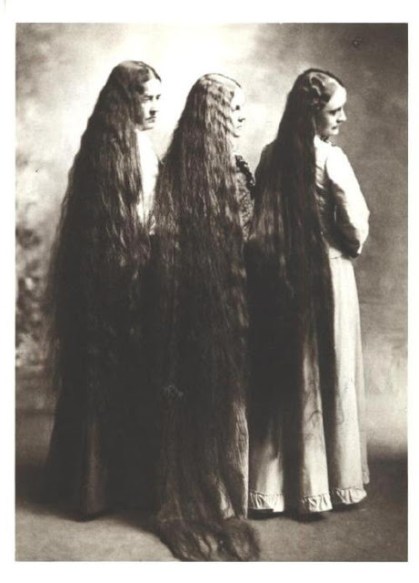
Historical women kept their hair clean, but that doesn’t mean their hair was often directly washed. Those who had incredibly difficult to manage hair might employ a hairdresser to help them wash, cut, and singe (yes, singe!) their hair as often as once a month, but for most women, hair-washing was, at most, a seasonal activity.
“Why?” you might ask. “Wasn’t their hair lank, smelly, and nasty?”
And the writers who embrace ignorance as a badge of honor will say, “Well, that just goes to show that people used to be gross and dirty, and that’s why I never bother with that historical accuracy stuff!”
And then I have to restrain myself from hitting them…
The reason that hair was rarely washed has to do with the nature of soaps versus modern shampoos. Soaps are made from a lye base and are alkaline. Hair and shampoo are acidic. Washing hair in soap makes it very dry, brittle, and tangly. Men’s hair was short enough and cut often enough that using soap didn’t harm it too much and the natural oils from the scalp could re-moisturize it fairly easily after even the harshest treatment, but in an age when the average woman’s hair was down to her waist, soap could literally destroy a woman’s head of hair in fairly short order.
Instead, indirect methods of hair-cleaning were used. Women washed their hair brushes daily, and the proverbial “100 strokes” were used to spread conditioning oils from roots to tips and to remove older or excess oil and dirt. This was more time-consuming than modern washing, and this is one of the reasons that “good hair” was a class marker. The fact that only women of the upper classes could afford all the various rats, rolls, and other fake additions to bulk out their real hair was another. (An average Victorian woman of the upper middle or upper class had more apparent “hair” in her hairstyle than women I know whose unbound hair falls well below their knees.) Women rarely wore their hair lose unless it was in the process of being put up or taken down–or unless they were having a picture specifically taken of it! At night, most women braided their hair for bed. Now that my hair is well below my waist, I understand why!
The first modern shampoo was introduced in the late 1920s. Shampoos clean hair quickly and also remove modern styling products, like hairspray and gel, but the frequent hair-washing that has become common leaves longer hair brittle even with the best modern formulations. (From the 1940s to the 1960s, many if not most middle-class women had their hair washed only once a week, at their hairdresser’s, where it was restyled for the next week. The professional hairdresser stepped into the void that the maid left when domestic service became rare. Washing one’s hair daily or every other day is a very recent development.) That’s where conditioners came into play. Many people have wondered how on earth women could have nice hair by modern standards before conditioners, but conditioners are made necessary by shampoos. Well-maintained hair of the 19th century didn’t need conditioners because the oils weren’t regularly stripped from it.
Additionally, the oils made hair much more manageable than most people’s is today, which made it possible for women to obtain elaborate hairstyles using combs and pins–without modern clips or sprays–to keep their hair in place. This is why hair dressers still like to work with “day-old” hair when making elaborate hairstyles.
There were hair products like oils for women to add shine and powders meant to help brush dirt out of hair, but they weren’t in very wide use at the time. Hair “tonics”–mean to be put on the hair or taken orally to make hair shinier, thicker, or stronger–were ineffective but were readily available and widely marketed.
If you have a heroine go through something particularly nasty–such as a fall into a pond or the like–then she should wash her hair, by all means. This would be done in a tub prepared for the purpose–not in the bath–and would involve dissolving soap shavings into a water and combine them with whatever other products were desired. Then a maid would wash the woman’s hair as she leaned either forward or backward to thoroughly wet and wash her hair. Rinsing would be another stage. The hair would NEVER be piled on the head. If you have greater than waist-length hair and have ever tried to wash it in a modern-sized bathtub, you understand why no one attempted to wash her hair in a hip bath or an old, short claw foot tub! It would be almost impossible.
A quick rundown of other hair facts:
Hydrogen peroxide was used to bleach hair from 1867. Before that, trying to bleach it with soda ash and sunlight was the most a girl could do. Henna was extremely popular from the 1870s through the 1890s, especially for covering gray hair, to such an extent that gray hair became almost unseen in certain circles in England in this time. Red hair was considered ugly up until the 1860s, when the public embracing of the feminine images as presented by the aesthetic movement (Pre-Raphaelite Brotherhood) gained ground, culminating in a positive rage for red hair in the 1870s to 1880s. Some truly scary metallic salt compounds were used to color hair with henna formulations by the late 19th century, often with unfortunate results.
Hair curling was popular in the 19th century and could either by achieved with rag rolls or hot tongs. Loose “sausage” rolls were the result of rag rolling. Hot tongs were used for making the “frizzled” bangs of the 1870s to 1880s–and “frizzled” they certainly were. The damage caused by the poor control of heating a curler over a gas jet or candle flame was substantial, and most women suffered burnt hair at one time or another. For this reason, a number of women chose to eschew the popular style and preserve their hair from such dangers! Permanents were first in use in the 1930s.
(From: http://www.lydiajoyce.com/blog/?p=1022)

 AUTHOR | HISTORIAN | ARTIST