The Melungeon Witch : Loved Cephea, book’s pacing was messy, fast, and all over the place though
Callie’s Mountain : I can get it for free if I wanted to but why would I subject myself to this torture? No, we don’t need some random white girl teaching us “mean Not White mountain folk how to be polite and smart instead of attacking innocent white women for no reason” fuck off Callie
Susannah’s Hope : Racist White Woman Has Decided, By Circumstance, To Not Be Racist For Five Minutes. That’s how the description comes off, but also We Can’t Get Married, I’m White And You’re Not. By the same author as the book above so no, I will not give it a chance.
Mother of Rain : I actually just found out about this, it’s an interesting premise I’m excited to read about.
Daughter of the Legend : Meh, same old same old cliche forbidden love because of race, nothing special besides a Melungeon main character
The Moon Eyed Ones : I AM IN LOVE SO FAR — remember the Vanovers? Silas and Isaiah? This is the book they’re from. It is fucking amazing, I love it to bits.
Basically I don’t trust anyone who hasn’t at least visited Appalachia to write it properly haha It’s not so much that I think it’s the Most Important Thing Ever, or that it’s complicated beyond non-Appalachian’s minds to understand, it’s just amazing how many writers from New York or Las Angeles will watch a hit-piece documentary basically meant to win somebody a Peabody and think they understand the intricacies of the region.
1. Believe it or not, we have updated our wardrobes since the 1910s. There are religious groups like the Amish and Mennonites who follow very strict lifestyle choices especially with clothing, but 90% of the average population even in the most poverty stricken areas wear blue jeans, converse, and t-shirts. Almost all of which will be with the logos of the local high school team. We’re poor, not a time capsule.
2. It’s difficult for people in the region, even LGBT people like myself, to completely dismiss religion or the church around here because they are a major community supporter. Every church I know and have been around, even if I didn’t appreciate the congregation, provide food, clothes, children’s toys, and more to the sick and poor around here because there are very few government institutions which provide those services. For example, I lived most of my life about an hour and a half from the nearest homeless shelter. There’s almost no public transportation that isn’t for senior citizens. If I had been kicked out of my home, like many people I knew in high school went through, and didn’t have a vehicle or friend who could drive them, there was literally nothing but the church and community members to help provide for you.
3. Appalachia actually does have a growing diversity, though it’s still very white. I went to school with more Latinx and Asian descended students than African-American. The exact reasons for this are actually something I haven’t looked into much. But even beyond that, there are historical minority groups in the region that are often forgotten or overlooked by people outside of the area. For example, Melungeons are a mixed race group of people from Appalachia who have African-American, Native American, and white heritage who have been around since the 1700s. They have been mistreated and erased by history quite a lot and it’s been pretty impactful on the culture for many people who can trace heritage back to them. There’s also a lot of unique genetic populations which have been the source of medical study at times such as the Blue Fugates, a family line prominent in some regions of Eastern Kentucky where I grew up where methemoglobinemia caused purple/blue discoloration of skin for some sufferers. Though, admittedly, the only girl I met in person who had this condition only had her fingers/ears turn blue with lack of circulation when she was cold.
4. The mafia has had a long history in the region since prohibition, especially since many regions of Appalachia didn’t remove their prohbition-era regulations and outlawing of the sell of alcohol and there are several areas which still regulate those things to this day. This feeds into a cycle of how the government in Appalachia absolutely screws over their limited economy because my hometown fought tooth and nail for all my middle school and early high school years against repealing prohibition even though we were losing businesses and restaurant chains being put in the county to surrounding counties which had lifted their bans. Fortunately they lost and we got about four new chain restaurants within the following year. Which is why immigration into the area has been so slow – the population is dying off, the economy has been ravaged over decades, and many areas are fighting for “tradition” which is literally driving out everyone in my generation out in droves just so we can find some means of surviving.
5. Eric C. Conn is the century’s greatest financial criminal mastermind, having made an entire multi-state SSI and Social Security scam where he hired multiple doctors and a judge in New York who had never even been to Appalachia to fake injuries and illness on literally thousands of people, driving real Social Security lawyers out of business and forcing people who either wanted to scam the federal government or had real disabilities but could only get a claim processed through him to come to him and thus forfeit the vast majority of their claim winnings to his operation. Everyone has known he was doing this – and in fact he openly advertised it on billboards and local commercials – since the 90s. The federal government ignored it until the Obama administration because Conn was such an idiot that he started paying for the infamous “Obama Girl” to start singing songs about him to try and put his name in the lottery for a position in the administration. This of course attracted federal and IRS attention. Some secretaries flipped on him and turned over his records, he was tried over the past four years and convicted but then last year in a surprise twist he escaped prison and ran into the deep woods of Appalachia where he’s still hiding and there’s one of the most massive federal manhunts in the country after him while the people he scammed over the years are no longer ever eligible for federal benefits again. FOR SOME REASON THIS ISN’T NATIONAL NEWS AND IT SHOCKS ME. There should be at LEAST fourteen documentaries and TV movies about this. also my dad and uncle went to high school with him and everyone hated him even then so this is all strangely amusing to us on a personal level http://www.kentucky.com/news/state/article157933819.html Like I haven’t covered even a TENTH of the crap with this story. People need to look this up. I didn’t even talk about the giant mannequins of himself he bought and posed all over the region. Or the Abe Lincoln and Statue of Liberty monuments he bought and put in his trailer park’s law firm’s parking lot. Like thee is so much I could say about this.
6. Everyone thinks it’s all coal here, and coal is a huge deal, but I know in Kentucky especially there’s actually tons of Natural Gas for fuel and stuff here too? It produces half the amount of emissions of coal and while not great would act as a great transition from coal industry here until we get on a completely Renewable system since a lot of the coal mining specialized workers could easily transfer those skills. But even though people have tried pushing for this in the state since the 80s and 90s, for SOME reason SOME politicians which I’m SURE aren’t paid by the industry at all, ignore this over and over again for driving coal into the long long long awaited grave it was heading toward anyway.
7. Appalachia has the largest biodiversity for newts and salamanders of anywhere in the continental United States. I don’t know what that could be used for in a story but here we are. You asked what I would like for more creative writers to keep in mind.
imma gonna stop because I literally could continue on this subject for another 25 years because I feel like my poor poor under appreciated friends have already heard at least half of my Appalachia Rants more than 20 times each.
tl;dr: maybe people shouldn’t write about the area but they definitely should hire me as a consultant or hell just the writer myself.
Happy New Year! This coming Tuesday marks the first day of the Lunar New Year in the US, so I’m going to give a little background on the holiday and how our Four Gods would have celebrated the holiday during the late Eastern Han. Most of you probably recognize the red and gold lanterns, decorations, and firecrackers, but everything in the Spring Festival holiday has a specific reason for its use.
First off, firecrackers were used as early as 200 BC in China, but the reason they are paired with red is because of a mythical monster called the Nian, which some say resembles the lion used in Chinese lion dances today. “Nian” (年) is the same word in Chinese for “year” and every New Year like clockwork, the Nian would emerge from its dwelling to eat nearby children and reign terror on the local people. The people soon learned though that the Nian was afraid of loud noises and the color red, so the next year, the villagers would decorate their houses with red talismans and lanterns and would set off fireworks to frighten the Nian away. To this day, fireworks, red decorations, and lion dances are used by Chinese communities everywhere to usher in good luck for the New Year.
In Gen’s time, these celebrations would be celebrated similarly, but also would stretch around fifteen days, with each day being dedicated to a specific deity or purpose. For example, the first day of the New Year was (and still is) dedicated to one’s elders and family, and a person is expected to visit their loved ones and give gifts, much how we Westerners do around Christmastime. But beware, certain gifts should be avoided. White or black items, clocks, scissors, knives, chrysanthemums, hats, and pears should not be given as gifts during this time, as they are either associated with funerals and death or they will cut off your good luck.
Ancestors that have passed away are also worshipped and paid their due respects during the holiday season, and home altars are cleaned and decorated to allow those gone before us to join in the festivities. Large dinners are held when everyone is gathered together, and staples of the holiday include golden egg rolls, dumplings, whole fish and/or chicken, and noodles. Gold foods represent wealth and good fortune, and chicken or fish are homophones with positive words in Chinese, sounding similar or the same to words for good luck or bringing in prosperity. Chinese culture has customs based all around homophones, and Chinese New Year is a holiday where you can see this custom in full force. Another homophone tradition is to get or make paper hangings with the character for good luck, called “fu” (福) in Chinese. In my house, I always hang my fu upside down, in Chinese it’s called “fu dao,” literally “luck upside down.” While Westerners may think this is a bad thing, “fu dao” also means “good luck has arrived,” so if you hang your fu upside down, it will bring you good luck. I’ve also heard some people say that they character for fu looks like a jar, and if you hang it upside down, the luck will pour out of it into your home and life.
In modern times, the Chinese New Year is only a public holiday for about five days, but Gen’s family and the gods alike would have celebrated it for the full fifteen-day span. The gods are said to celebrate the New Year just like we mortals do, as the gods who reside on Earth report back to the Jade Emperor at this time. A huge party is thrown, and the gods gather together to feast and to report their yearly findings on us wee humans that they observed during the year. The god of wealth, the water gods, and the kitchen god are three important deities respected during this time. On the first day, the water gods are to be respected by conserving water. According to tradition, bathing and doing laundry is bad luck today, as not only are you disrespecting the water gods, but you are also washing away any good luck that may come to you. The kitchen god is one of the main deities, and if you have a statue of this god, it’s a tradition that honey or rice syrup is spread across his mouth. The reason for this is that when he ascends to report on your activities over the last year, if you give him honey to eat, he’ll only be able to tell the Jade Emperor the sweetest things about you and your family. The Jade Emperor is celebrated with a massive feast on the tenth day, and throughout the holiday, mainly on New Year’s Eve and New Year’s Day, mythical beasts such as the lion and dragon are celebrated with elaborate dances. Sometimes in other communities like the Hakka, the Qilin dance is also important to scare away evil spirits and bring about good luck. It’s also extremely good luck if one sees a Fenghuang around this time, as they are omens of prosperity, but this is a rare occurrence.
The last day of the New Year is the Lantern Festival. This day is also the god of good fortune’s birthday, but some legends say that the festival was started because of the Jade Emperor’s temper. Legends state that a mythical crane left Heaven and flew down to earth and alighted in a small village. The crane was the Jade Emperor’s favorite companion, and it angered him that the crane was being kept on Earth. He planned to punish the people by setting their village ablaze, but the people were warned by his daughter of what was to come. The people, desperate for a solution, then lit an abundance of lanterns, bonfires, and fireworks to give off the illusion that their town was already in flames. The Heavenly troops were fooled by this illusion, and to celebrate their village being spared, lanterns and fireworks are lit yearly on this day. During Gen’s time, this Festival was of utmost importance along with the New Year itself, as families would light lanterns and make nighttime visits to their respective temples. This holiday was also a fun time for children to solve riddles posted around their temples, but during Gen’s time, this custom was mainly dedicated to the god of the North Star and to bring in light to beckon the coming of spring. This festival was (and is) also celebrated with gala performances, dances, and treats of sweet rice balls. In 2019, the Lantern Festival will fall on February 15th.
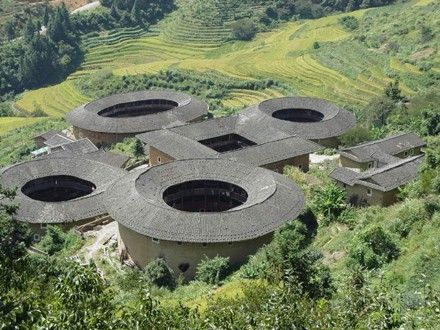
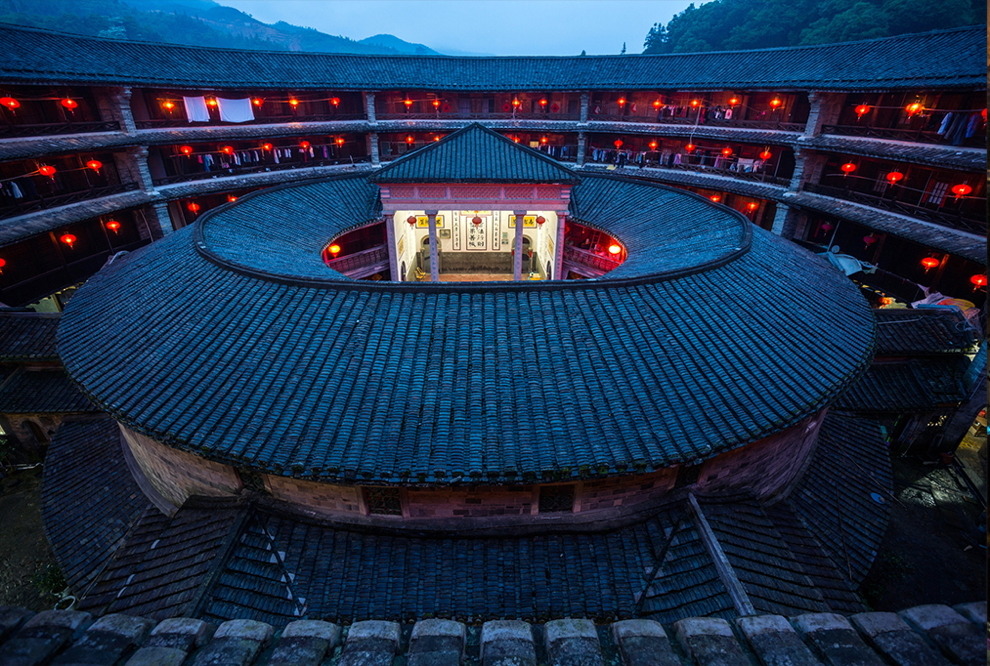
In this post, I’ll be discussing the architecture of the Si Ling compound. In Prince of the North, Gen notices that the “palace” the Si Ling live and work in is nothing like the palace he is used to. He describes it as being round in shape with four floors and one central courtyard/garden area for socializing and for meals. This structure is based on the Fujian tulou structures (although I admit that most tulou would have been constructed centuries after the time period that Prince of the North takes place in.) The reason I based the palace off of these fortresses is because 1) In Chinese myth, Heaven is round and Earth is square, so the round shape is representative of Heaven, 2) I needed a building that 4 or more people could live, work, and thrive in without having to run from one end of a gigantic complex to another (If any of you have seen old Chinese palaces, the distance between some of the buildings and offices is astounding), 3) Tulou are built to be in accordance with bagua principles, or the eight trigrams that work with the harmony of yin and yang, which fits perfectly for an organization that works in harmony.
Now let’s talk about the tulou of reality: tulou are earthen fortresses constructed by the people of Fujian province, mainly the Hakka people. Once finished, their walls can average about 6 feet thick and they are known for being earthquake-proof and wind-proof. Many of the tulou of Fujian date back to the 1300 and 1400s (while still remaining functional, too! Many families still live in these fortresses today). The largest tulou is around 254 feet in diameter and most stand at 3 to 5 floors. The most interesting thing about tulou fortresses is that they house families and people as equals. No section or wing is larger nor more elaborate than another, and everyone’s private quarters are of the same quality. While larger groups would have larger sections of the tulou for their family, every family is ranked equally when living together in the tulou, which is another reason I wanted to base the Si Ling mansion off of this structure: once inside, all four men are equals.
As for the Si Ling mansion, the rundown is this:
There are 4 wings: Qinglong, Xuanwu, Baihu, and Zhuque. Each wing is color coordinated to match the astrological colors of each sign, Qinglong is decorated in blues and greens, Xuanwu is decorated in greens and blacks, Baihu is decorated in whites and golds, and Zhuque is decorated in reds, pinks, and oranges. The communal areas are situated between the Qinglong and Zhuque wings, as well as in the center of the palace. They are decorated in violet and burgundy. Each wing (aside from the communal wing, which is smaller) takes up an equal amount of square footage of the mansion and each sign owns the four floors within their wing going vertically from bottom to top.
1st floor- courtyard, kitchens, and dining areas. Private kitchens and dining rooms are sectioned off for each member, but a communal kitchen is available off of the courtyard.
2nd floor- offices, studies, pharmacies, and laboratories. The offices and libraries are on this level, and a public office sits above the communal kitchen for all four to use if need be.
3rd floor- bathrooms. Bathhouse areas are on this floor.
4th floor- private wings and bedrooms. All bedrooms are located on the top level, and although only the 4 members of the organization live in the mansion at a time, each wing contains up to 4 separate bedrooms for guests, family, or other deities who may require it.
Observatory- The observatory is a separate building off to the east side of the mansion and is used for all astrological work.
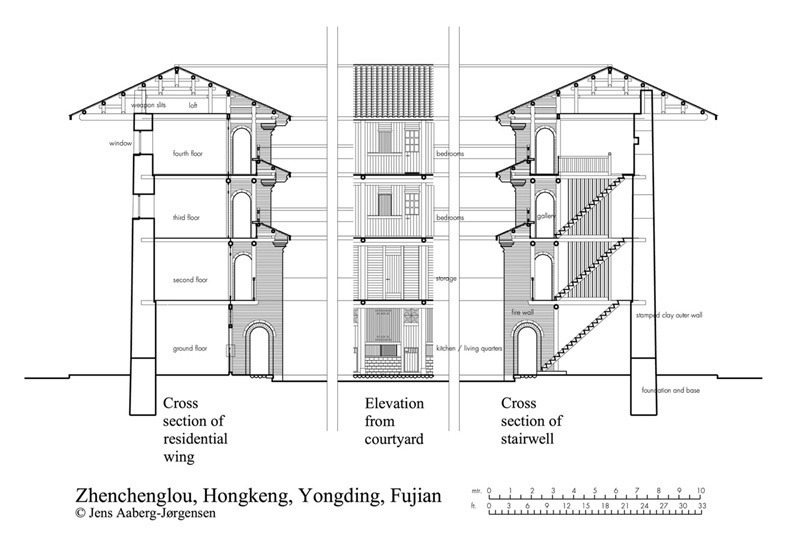
Like most tulou, the Si Ling mansion only has one gate on the west side, which leads directly to other buildings in Heaven such as the Flower House and the palace of the Jade Emperor. Unlike earthly tulou, there is a main staircase connecting the bedrooms to the courtyard, and this staircase is located on the inner side of the south wing. However, staircases also link the other wings to their floors and courtyards, but these are located in the inner corners of each wing.
An example would be something like this, found in the Zhengchenglou fortress:
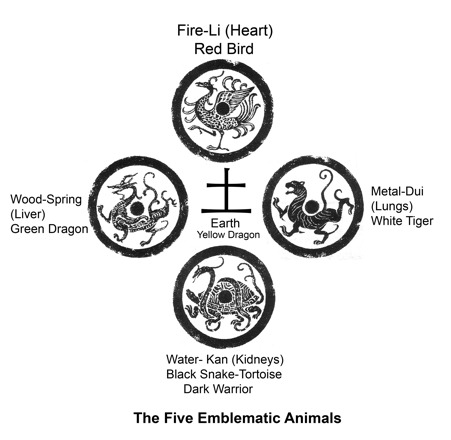
Xuanwu (Dark Warrior)– Represented by a Black Snake twisting around a Tortoise, Xuanwu is associated with all things water. In The Four Gods, Gen struggles with mastering his qi, especially because he learns that using too much to manifest his powers leads to exhaustion. The center of his powers rest in his endocrine system, and using too much causes him pain, fatigue, and confusion. Once he gets the hang of things, his powers manifest in the forms of ice and sea plants.
Zhuque (Red Bird)– Represented by a red bird, Zhuque is represented by the passionate element of fire. Fengge is often caught using his powers when he needs them least, such as starting fires for cooking or warmth. Fengge however, has mastered the use of his qi, though becoming too reckless with it causes him heart palpitations, shortness of breath, and weakness, as the center of his powers rest in his circulatory system. Fengge also possesses clairvoyance and minor psychic abilities such as future sight and telekinesis.
Qinglong (Green/Azure Dragon)-Represented by a teal dragon, the element of this god is actually wood, not water as it is often mistaken for. Longwei is an interesting case, in that he is actually a storm dragon, not strictly a water dragon, but his qi manifests mainly in the use of sea plants, vines, and thorns. His center for his powers rest in his digestive system, and he becomes lucky in that overuse only causes pain and fatigue. He shares many of his abilities with Gen, and their qi manifestations are eerily similar, only because Longwei lends many of his powers to Gen as the leader of the Si Ling Organization.
Baihu (White Tiger)- And lastly, we come to the enigmatic god of the four. Chonglin is a Qilin, not a white tiger as shown in most of the astrological charts, mainly because the Qilin is not only a member of the four sacred beasts but also, it was a more ancient symbol for the western direction before the white tiger became the symbol. Despite this difference, Chonglin’s element of metal is the same, and he also shares the Lake trigram with Baihu. Like Baihu, the center of his powers rests in his lungs, as the lungs provide the tiger’s power when it roars and provides the Qilin power when it blows its fiery breath. Chonglin’s qi manifests as metal shards, gems, and thunder/lightning, as metal is a conductor for electricity. Like Fengge, Chonglin possesses clairvoyance, future sight, and telekinetic abilities, though he has much more mastery over his abilities than Fengge. Overuse of his powers causes shortness of breath, pain, and fatigue.














 AUTHOR | HISTORIAN | ARTIST