
After putting my writing on hold for several weeks, I decided to jump back in. I expected to find all sorts of problems with my story–inconsistencies in the plot, lack of transitions, poor characterization–the works. But what began to stick out to me was something to which I’d given little thought in writing.
Filter words.
What are Filter Words?
Actually, I didn’t even know these insidious creatures had a name until I started combing the internet for info.
Filter words are those that unnecessarily filter the reader’s experience through a character’s point of view. Dark Angel’s Blog says:
“Filtering” is when you place a character between the detail you want to present and the reader. The term was started by Janet Burroway in her book On Writing.
In terms of example, you should watch out for:
- To see
- To hear
- To think
- To touch
- To wonder
- To realize
- To watch
- To look
- To seem
- To feel (or feel like)
- Can
- To decide
- To sound (or sound like)
- To know
I’m being honest when I say my manuscript is filled with these words, and the majority of them need to be edited out.
What do Filter Words Look Like?
Let’s imagine a character in your novel is walking down a street during peak hour.
You might, for example, write:
Sarah felt a sinking feeling as she realized she’d forgotten her purse back at the cafe across the street. She saw cars filing past, their bumpers end-to-end. She heard the impatient honk of horns and wondered how she could quickly cross the busy road before someone took off with her bag. But the traffic seemed impenetrable, and she decided to run to the intersection at the end of the block.
Eliminating the bolded words removes the filters that distances us, the readers, from this character’s experience:
Sarah’s stomach sank. Her purse—she’d forgotten it back at the cafe across the street. Cars filed past, their bumpers end-to-end. Horns honked impatiently. Could she make it across the road before someone took off with her bag? She ran past the impenetrable stream of traffic, toward the intersection at the end of the block.
Are Filter Words Ever Acceptable?
Of course, there are usually exceptions to every rule.
Just because filter words tend to be weak doesn’t mean they never have a place in our writing. Sometimes they are helpful and even necessary.
Susan Dennard of Let The Words Flow writes that we should use filter words when they are critical to the meaning of the sentence.
If there’s no better way to phrase something than to use a filter word, then it’s probably okay to do so.
Want to know more?
Read these other helpful articles on filter words and more great writing tips:
-
-
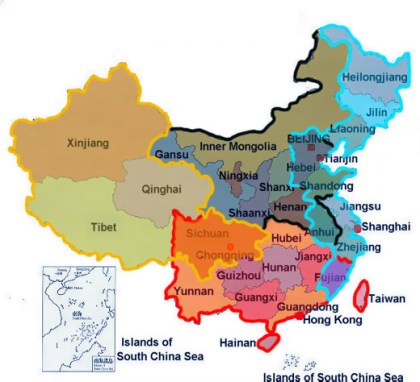
For this week’s #FourGodsFridays, I wanted to do a simple map the quadrants of China that the Four Gods rule over. Please note that this is using a modern map of China and not the correct borders of the historical Han or Three Kingdoms. The gold are Chonglin’s territories, the black are Gen’s, the light blue are Longwei’s, and the red are Fengge’s. Also note that Fengge has reign over the islands of the South China sea as well. Some of the territories are shared through overlap, and their directions also correlate to which constellations and celestial bodies they control.
In Book 1, Gen mentions having expeditions in the Ordos among nomadic tribes there, which runs through the present-day provinces of Shaanxi, Ninxia, and Inner Mongolia. These were the most northern borders of China at the time the story takes place. Chonglin’s borders would have overlapped more with Fengge’s as China’s most western border during this period would be Sichuan and up to western Xinjiang. Longwei’s territories would have extended east into what is now North Korea, and Fengge’s would go even further south into what is now Vietnam.
-
Hey all! I’ve just gotten back from Gen Con and there were TONS of writing seminars there, one being how to write alternative history. Historical fiction, sci-fi, and fantasy have become so intertwined lately and a lot of writers are delving into the genre to start meshing more popular genres with historical backdrops. Seeing as how The Four Gods is a historical fantasy and alternative history and how relevant those panels were, I thought a review on some basics of historical fiction writing would be in order.
1. Pick Your Poison
First and foremost, choose your time period and area of historical fiction you will be writing in. Don’t you know, historical fiction has multiple sub-categories like all genres! Are you writing traditional historical fiction that only encompasses an event that could have happened in a given time period? Are you writing speculative fiction that involves fantasy, sci-fi, and a lot of what-ifs with famous events? Whatever you choose, pick your time period, get an idea of your characters, and get your time machine ready.
2. Research
Research is key to demonstrating sufficient knowledge of the period you have chosen to write about. Look into books, articles, and if you can, interviews– or as I like to call it, “hands-on history.” You also have to know how to research. Wikipedia is a good springboard, but should never be used by itself. Look into the source list of the article you’re reading, or if you pick up books or physical articles from academic sources, look at their sources. Of course, it is up to each author to how much research is necessary, which depends on how deep your manuscript goes into the time period you have chosen.
If you are still in college and have access to online libraries, use them! JSTOR and EBSCOHost were invaluable research tools that I had at my disposal since I began writing The Moon-Eyed Ones when I was still in my Master’s program.
As for my “hands-on history” approach, museums and primary sources are wonderful tools. For instance, The Moon-Eyed Ones takes place in 1835-38 Tennessee, which was based on the area my family lives in. I used the Museum of the Cherokee Indian in North Carolina and Conner Prairie Interactive History Park here in Indianapolis as two of my big resources, as the Cherokee Museum has artifacts and tidbits I had missed, and Conner Prairie as an interactive setting let me use all of my senses and completely immerse myself into what it may have been like to live in the mid 1830s (and have a little fun on top of that :P).
Note: Also be prepared, depending on your subject matter, to run across sources in multiple languages.
3. Character Construction and World Building
Characters are the lifeblood of a story, and when writing historical fiction, you may have more restrictions than if you were writing in another genre. Your characters must conform to the time period you have chosen. For example, Silas in The Moon-Eyed Ones is affected by laws at the time that forbid him from voting or having a voice in public hearings. Because of his race (or perceived race), he is forbidden from certain activities that he would have no problems doing if he lived today. Be careful to not include references or abilities to modern privileges or luxuries. If you are writing speculative fiction, then you have a little more free space to run around and mess up the space-time continuum or include inaccuracies.
Same goes for your setting. What do houses or buildings look like? Did your character have access to electricity, running water, or transportation other than their own two feet? How accessible were stores, towns, or other gathering places? What occupations were available? How does your character eat, dress, or bathe, and how often? Keep an eye on modern amenities trying to sneak their way into your manuscript, as you may be shocked to find out that your dashing male lead may have only bathed once every week or two.
4. Say what?!
Language is important when your characters are speaking, especially if your story takes place many centuries in the past. I myself find this one of the most challenging aspects of writing historical fiction because while I would like everything to be accurate as possible, I would also like my story to be readable. For example, back in the 18th and early 19th centuries, Melungeons have been noted by some sources to have spoken a hodgepodge of Elizabethan English and the American English we know today. The language patterns are still apparent in many dialects of the Southern American accent, but how far is too far? Tread lightly here, and pepper in what you can, but use beta reviews and other reader opinions to gauge if your characters sound too modern or if they can’t be understood at all.
Another note on this is that depending on your time period, the people in your story may have a few things to say about certain things that would seem racist, offensive, and downright horrifying to our modern sensibilities. The “How far is too far?” question arises here more than ever, and while I personally don’t like sacrificing historical accuracy to make everyone sing Kumbaya, it all depends on your manuscript. But in this regard especially, should you run into this problem, be prepared to make your readers uncomfortable.
5. Read!
Yes, read! I personally like reading books with similar subject matter and in similar settings when I am writing, but reading, in general, is a given (especially because you’ll be researching). When I was writing the first draft of The Moon-Eyed Ones, I went for any fiction that involved Melungeons, Cherokees, or the American South in the 19th and early 20th C. To be honest, I didn’t enjoy every single book I picked up, but reading gave me insight on what I enjoyed, how the writing was executed in regards to the points above, or even what not to do. Reading makes you a better writer and can give you a better idea of what you want your manuscript to accomplish.
—-
And there you have it, the top 5 aspects of getting that historical fiction novel written! Of course, these are true with any piece of fiction and keeping your writing on track.
-
-
-
-
-
Hi, thanks for the question! I covered the basic types of men’s hanfu here and here, so in this post I’ll describe the basic types of women’s hanfu. Resources on identifying different types of hanfu can be found in my reference tag.
– Ruqun/襦裙 – the most basic type of hanfu consisting of a top and a wrap-around skirt. The top is called “ru/襦” and the skirt is called “qun/ 裙”, hence “ruqun”. Sleeves can be narrow or wide. Generally speaking, people divide ruqun into two types based on the height of the skirt: “Qiyao Ruqun/ 齐腰襦裙” (waist-high ruqun) and “Qixiong Ruqun/ 齐胸襦裙” (chest-high ruqun).
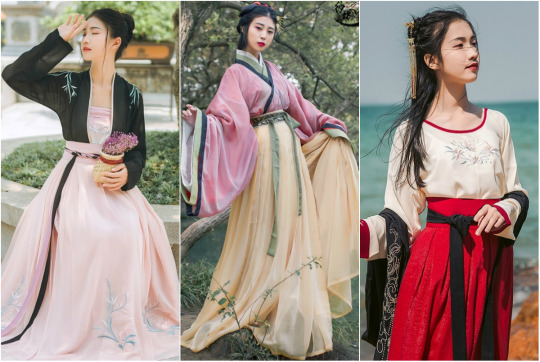
“Qiyao Ruqun” is the kind of ruqun in which the waistband is on the waist. Both men and women can wear it. For women, the top’s collar can be parallel (left), crossed (middle), or u-shaped (right). Men’s ruqun are cross-collared only.
“Qixiong Ruqun”, on the other hand, has its waistband above the chest. The top’s collar can be parallel (left) or crossed (right). It’s only worn by women.
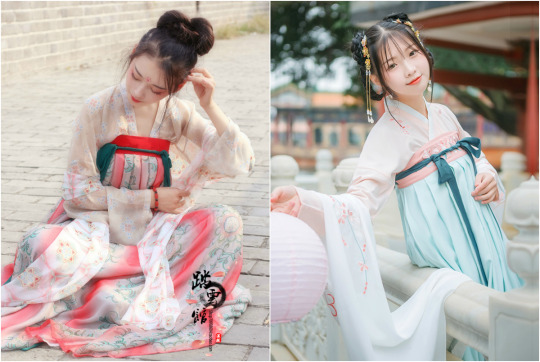
As seen in the photos above, ruqun is often accessorized with a long scarf called Pibo/披帛. Originally used to protect against wind and cold air, pibo gradually became an important feature of hanfu.
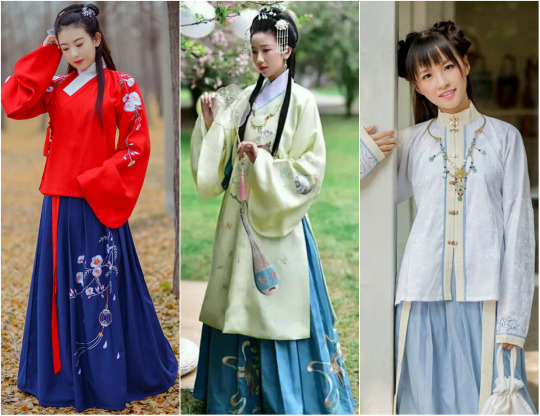
– Aoqun/袄裙 – a type of ruqun that became fashionable during the Ming Dynasty. It consists of a double-layered top called “ao/袄“ and a waist-high skirt (”qun”), hence “aoqun”. Unlike the “standard” ruqun that has the top tucked inside the skirt, the aoqun’s top is worn untucked, above the skirt. There are two types of “ao” – “short ao” and “long ao”. The “short ao” (left, right) reaches the waist, while the “long ao” (middle) covers the knees. Ao collars can be crossed (left, middle) or upright (right). Only worn by women.
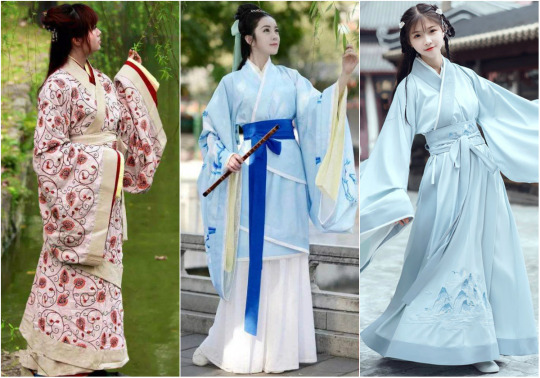
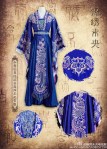
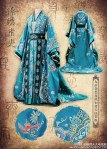
– Unlike ruqun and aoqun which are made of separate top and bottom pieces, the Shenyi/深衣 style of hanfu consists of one-piece robes that wrap around the body once or several times. Quju/曲裾 (curved-hem robe) and Zhiju/直裾(straight-hem robe) are two types of shenyi. The quju (left, middle) is a robe in which the bottom hem of the left lapel spirals its way up to the waist of the wearer. Modern quju can come in a shortened version (middle) that reveals the skirt worn underneath. In contrast to the quju, the bottom hem of the zhiju (right) circles around levelly, creating a straight line. Quju and Zhiju are worn by both men and women.
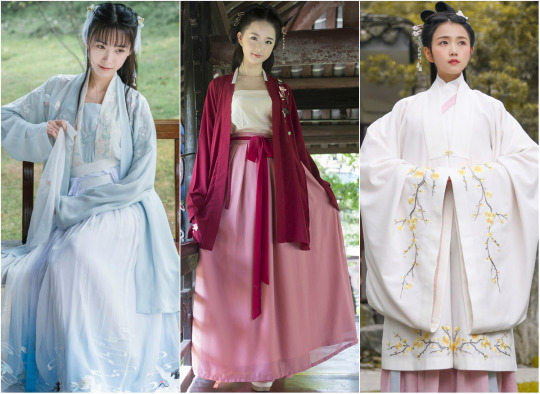
– Beizi/褙子 – a parallel-collar “jacket” with side slits beginning at the armpit or at the waist. It can be secured at the front either with ties or a metal button. Extremely versatile, it can be long or short, have narrow or wide sleeves, and is worn by both men and women. During the Song Dynasty, it was popular to wear narrow-sleeved beizi over a chest undergarment and skirt/pants (middle). Another name for Ming Dynasty-style beizi is Pifeng/披风 (right). Pifeng collars can also be upright (not shown).
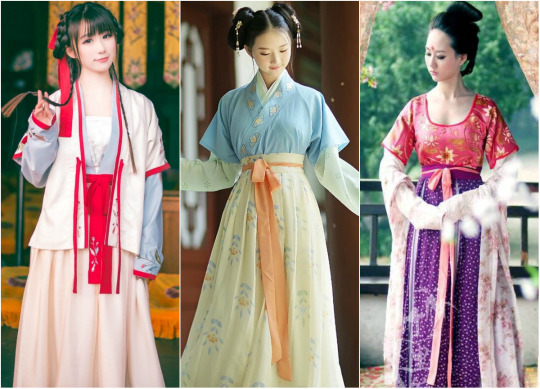
– Banbi/半臂 – a half-sleeve jacket worn by both men and women. It comes in various lengths and is usually worn over ruqun. Its collar can be parallel (left), crossed (middle), or u-shaped (right). When paired with ruqun, it can be worn tucked inside the skirt as well as over the skirt (untucked).
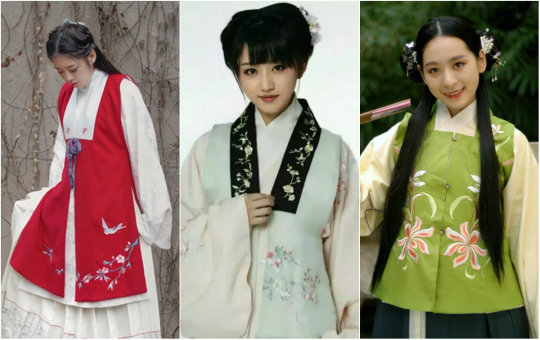
– Bijia/比甲 – a sleeveless jacket, usually worn over aoqun, that comes in various lengths and styles.
– Daxiushan/大袖衫 – large-sleeve robe commonly paired with ruqun. As its name indicates, its main feature is its broad sleeves. The length is at least 78 inches, and the width exceeds 40 inches. The material is generally thin and light, because it was originally created for wear in the summer.
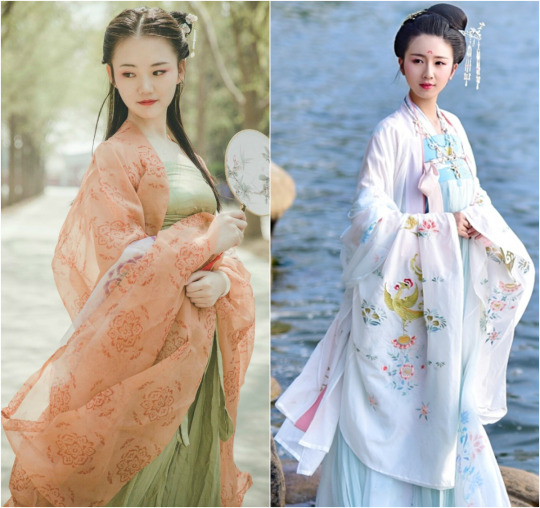
Of course this doesn’t cover everything, but it describes the basic hanfu styles that appear most often on this blog. Hope this helps!







 AUTHOR | HISTORIAN | ARTIST