The Wu Xing (Chinese: 五行; pinyin: Wǔ Xíng), also known as the Five Elements or Five Phases, is one of the major systems of thought within traditional Chinese fields including Chinese medicine, Feng Shui, Astrology, Music, Military Strategy and Martial arts.
A Short History The Wu Xing theory was originally a moral theory and evolved from the doctrines of the Confuciuan school (or Zi-Si-Mencius school). Later, In the third century BCE Zou Yan combined and systematized two current theories during the Warring States period: Yin-Yang and the Wuxing.
*personal note: the Wuxing seem to be related to the Eight Trigrams (bagua) from the I Ching, the original version of the I Ching (it was edited by King Wen in 2852 BC) goes back to the supposed writer Fuxi, the legendary ruler.
A closer look at the Five Phases Ultimately the natural cycles and interrelationships in both our environment and within ourselves have let to the theory of the Wu Xing. The foundation of the theory rests in the correspondences of each element to a variety of phenomena.
These “Five Phases” are Wood (木 mù) Fire (火 huǒ) Earth (土 tǔ) Metal (金 jīn) Water (水 shuǐ)
Wood Wood is flexible, like bamboo. It grows and expands. It is also associated with qualities of generosity and idealism and leadership. It is the leader within us, that can take charge and determine a plan of action. Spring is the season of wood and it is the period of sprouting. The color associated with wood is green. In Chinese Medicine the liver is the organ of wood.
Fire In Chinese thought Fire is passionate, it is joy, laughter and playfulness. But also the qualities of dynamism, strength and persistence; however, it is also connected to restlessness. Summer is the season of fire and it is the period of blooming. The color associated with fire is red. In Chinese Medicine the heart is the organ of fire.
Earth Earth is patient, thoughtful, practical and hard working. It brings harmony and stability. Late summer is associated with earth and it is the period of Ripening. The Color of Earth is yellow. In Chinese Medicine the spleen is the organ of earth.
Metal Metal is unyielding, rigid and persistence.
Metal type people like minimalism. They are organized, clean, and contained. The Fall is associated with metal and it is the period of withering. The Color is white. In Chinese Medicine the Lungs are the organ of metal.
Water In Chinese Taoist thought, water is representative of intelligence and wisdom, flexibility, softness and pliancy. Water can be weak like fluid but it can also turn into a flood and overwhelm the land. The winter is the season of water and it is the period of dormancy. The color of Water is black. In Chinese Medicine the Kidneys are the organ of water.
Elements or Phases You will often see Wu xing translated as “Five Elements” but the Xíng are primarily concerned with process and change, they are not the same as the classical Greek elements that are concerned with substances or natural qualities.
The Changing qualities or Cycles are:
Generating The Xing are Inter-promoting, often called like mother and child. Wood for example is the mother of Fire. You can easily see this because Fire comes after Wood (clockwise) so in that way Wood feeds Fire, like a mother would. In this way all the Phases can be listed as:
Wood feeds Fire Fire creates Earth (ash) Earth bears Metal Metal enriches Water Water nourishes Wood
This Cycle of is called the 五行相生 Sheng Cycle (Generating Sequence)
Controling Each Phase controls or keeps another element in balance, much like Yin and Yang keep each other in balance. In the Wuxing, it will come as little surprise that Water controls Fire and Metal controls Wood. While some of the others are a bit less obvious, it will become clearer when you understand that the five elements all have specific qualities that go beyond just metal chopping wood.
All the elements Controlling sequence can be listed as:
Wood controls Earth Fire controls Metal Earth controls Water Metal controls Wood Water controls Fire
This Cycle is called the 五行相剋 Controlling Sequence or Father-Child relationship.
Other than these two cycles, the Overacting Cycle (when an element controls too much) and the Insulting sequence (when for example fire starts heating water instead of water extinguishing fire) also exist.
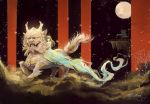
The lion dance, is a form of traditional dance performed on joyous festivals and big occasions, such as the Spring Festival (Chinese New Year). It is a dance which imitates a lion’s various movements and actions, performed in a lion costume, accompanied by the music of beating drums and gong instruments.
It is believed that the lion is an auspicious animal that brings good luck.Therefore, a lion dance is performed to pray for good luck during the Spring Festival or during other celebrations.
The lion dance is an excellent Chinese folk art that has spread across the world, courtesy of local Chinese communities and immigrant groups who have settled in different countries, particularly in Malaysia and Singapore. Also, the overseas Chinese people in European countries and America have established many lion dance clubs, performing on Chinese festivals or on big occasions.
Origin
Opinions about the origin of the lion dance are widely divided. The most reliable one is this:
In traditional Chinese culture, the lion, like the dragon and the Chinese unicorn (麒麟), was only an animal which existed in myth, and there were no actual lions in China. Before the Han Dynasty (202 BC – 220 AD), only a few lions had reached the Central Plains from the western area of ancient China (now Xinjiang).
At that time, people mimicked the appearance and actions of the newly arrived lions in a performance, which developed into the lion dance in the Three Kingdoms Period (220–280) and then became popular with the rise of Buddhism in the Northern and Southern Dynasties (420–589). In the Tang Dynasty (618–907), the lion dance was one of the court dances.
Styles
The Lion dance was divided into two styles,
The Northern Lion dance:
The northern lion dance has close relations to wushu (martial arts). Usually, a young lion is performed by a single person and an adult lion is performed by a duo.
The southern Lion dance:
The southern lion dance originated from Guangdong, and it is famous in Hong Kong, Macau, and the hometowns of overseas Chinese people. The southern lion dance is also performed in pairs, and the performers wear a lion costume. The southern lion dance is a performance based on the study of a lion’s behavior.
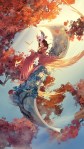
The peacock dance 孔雀舞 is one of the most wide-spread ancient dances of the Dai ethnic group in Yunnan Province on the southwest border of China. Tropical weather and nature have nourished the Dai people’s tradition and culture. They share their land with creatures of great variety. The beauty and kindness of the peacock inspires the Dai culture to a great extent and the Dai consider the peacock as a Goddess that can bring them peace and happiness. They pray for peace and happiness with graceful peacock dancing.
Culture
The peacock dance is the best-loved dance of the Dai. To the Dai the peacock is a symbol of good luck, happiness, beauty and honesty, so to perform this dance is to present a eulogy of and express good wishes for a happy life. It is mostly performed on the New Year (Water-splashing Festival) of the Dai calendar, at the Gate Closing Festival, the Gate Opening Festival and some important religious events.
History
The Dai, known for their singing and dancing skills, worship the peacock. The peacock is a precious bird in the sub-tropical zone. It is beautiful and tame. To the Dai ethnic group, it stands for auspiciousness and beauty. The Peacock Dance reflects their respect for peace, honesty, water and beauty. The Dai people believe in Hinayana. In the scripture, the Peacock Rajas (Bright King) is a Bodhisattva flying on a peacock, with a lotus and a peacock tail in hand. Therefore, the Dai people love peacocks, tame peacocks and dance the Peacock Dance.
According to folk custom, the peacock dance used to be performed by men. They had to shoulder heavy props such as wings, therefore, their actions were restrained. Breaking through the boundaries of tradition, the creators tried to display the peacock’s beauty by giving the part to women. They got rid of the heavy wings and they wore long broad skirts decorated with peacock feathers.
Movements
The movements of the dance are quite diverse, the movements in the dance copy the movements of a peacock. The most common hand gestures include tucking the thumb under with the four fingers extended close together, the “peacock hand” (the thumb slightly tucked, the index finger bent and the other three fingers spread in a fan shape), and the “eye” gesture (the thumb and index finger close to each other and the other three fingers spread in a fan shape to imitate the shape of an eye). The dance steps include tiptoeing and undulating steps such as kicking one foot backward toward the hip, stepping back, then stretching and bending the other leg in rhythm.







 AUTHOR | HISTORIAN | ARTIST