The beginning of a story is relatively easy. The
idea is fresh, and it’s exciting thinking up character names and placing them
in a setting. However, once you hit that first plot point, you’re going to need
to dig deep to continue with and finish your story.
Every writer writes shit out of the gate. Give
yourself permission to write crap, don’t obsess over sentences. Sometimes a
particular scene does not work the first time, that’s what editing is for.
You will learn more from finishing a book than
rewriting the same chapter over and over.
There is a right/wrong way to write a book
Every craft book, youtube video, podcast, and writing
blog you’ll come across is one way of doing it, not THE way of doing it.
Figure yourself out as a writer. Dabble with
different methods and find what works for you, personalize your craft to fit
your own style.
You have to write fast to succeed
Writers need to put out their best book, no
matter how long it takes.
Be honest with yourself, build time in your
schedule to write and take note of how long it takes you to complete a book from
plotting, to drafting, to editing.
Writers progress at different rates, don’t
compare someone’s pace to your own.
There is a best way to publish
There is no right or wrong way to publish,
understand the industry and what you can handle.
If you have no time or interest to produce your
book so it’s market ready – go traditional
If you want to retain full creative control of
your book – self publish.
Keep in mind you can cross publish, meaning
traditionally publish some books and self-publish others. You don’t have to stick to one form of
publishing.
Following trends will lead to success
From draft to publication is a lengthy progress.
Trends change fast, following them and producing a quality book in record time
is near impossible.
When you write a book, be prepared to re-write
that book at least five times. Writing something you love as opposed to chasing
a trend will make that job a lot easier.
Success will come from producing a quality book
in a genre and market that you love, not from chasing what is currently en vogue.
As we dive into the NaNo Prep season, we’ve asked NaNoWriMo participants who’ve published their NaNo-novels for their writing tips on everything from inspiration to avoiding plot holes. Today, Dan Koboldt, author of The Rogue Retrieval, shares the three most important writing lessons he’s learned:
When I began writing fiction in 2008, I thought it would be easy. At the time, I had a number of research papers and nonfiction articles under my belt. I considered myself a fairly good writer, in fact. Then I took my first course in fiction writing. As the class critiqued my first-ever short story, it became painfully obvious that I was fairly terrible at it.
Although I cut my teeth on short fiction, it wasn’t until I began writing novels that I really leveled up. I won my first NaNoWriMo in 2009. That book will never see the light of day, but I was learning. I landed a literary agent in 2014, and signed a book deal with Harper Voyager in 2015. Here are three of the most important things I learned along the way.
For me the most annoying examples of historical inaccuracy + Horseshoe Theory are when people claim to be against racism but they’re so Western-centric they think imperialism and racism was a European-only enterprise. And so, they go so far around the bend that they romanticise and fetishise powerful and expansionist non-European empires that were no less imperialist than the European empires they rail against.
i’m sure you guys know because i talk about it a lot on my blog- but some of the biggest offenders here include the mind-boggling manner in which the Empire of Japan is championed as an “anti-colonial” force (even though it was an undisguised colonial power that caused a destructive conflict that left 25 million people dead in Asia). or the Ottoman Empire- when people disregard its genocide of Armenians, Assyrians and Greeks. we cannot claim to be anti-imperialist if we’re gonna be OK with it or assume it is somehow less serious because the imperialists are not white by Western standards. nor can we claim to be against Western imperialism because perpetuating Western-centric history is itself a manifestation of Western cultural imperialism.
Ignoring the capacity of non-European empires for war, racism and even genocide just to present a photoshopped version of them as somehow being 100% utopian, enlightened examples of “anti-colonial” state-building amounts to actively erasing non-European history. This is not seeing non-Europeans as fully actualised and complex human beings who, like all human cultures, could produce works of art, science and philosophy while also engaging in warfare and violence. The idea that the world was peaceful before the rise of European imperialism suggests the outlines of the world were always the same, that the modern concept of Europe was eternal (see the Roman Empire, which plainly saw Northern Europeans as uncivilised barbarians). It suggests Europeans were perpetually at the nexus of global power. When they were not.
my favorite post so far
Why cant we just ignore it, because it all happened hundreds and hundreds of years ago?
Because knowing what really happened is important.
Its important to know what happened, okay, I agree, but why do we have to attack any culture or country in the first place because of what they did way in the past? Thats more what I meant.
-the two examples i listed happened in the 20th century
-denial of the Armenian Genocide & Japanese war crimes is still an issue today. same with so many other atrocities? like people trying to whitewash slavery, saying the American Civil War wasn’t about slavery… it affects modern racial, religious, political dynamics today and is key to understanding why the world is the way it is? the past isn’t even past, for the most part. the past exists in continuum with the present it helped to create. how do we look at what society we want to create if we have no reference points for what created the various inequities present today or points of comparison as to what direction we want to go in? the universal declaration of human rights, the genocide convention were written by those who witnessed the atrocities inflicted during WW2
-let’s get out of this mentality that just reciting unsavoury but true historical facts is unduly ‘attacking’ a culture or country honestly? the entire crux of my post is: if you want to do non-European history justice, let’s not romanticise or engage in erasure. this applies every bit to all history tbh. like i am comfortable with and celebrate my culture but i will not be making excuses for the ugly parts of chinese history cos they are every bit our history and part of who we are as all the “good” things like inventing paper or spreading tea drinking
This here is exactly why I am so cautious of people who say “I want to remove European [or, sometimes, they only say “English”] colonialism to respect Indigenous peoples.” It’s not that simple. Genocide is a global issue and empires around the world have done atrocious things to various Indigenous populations. Native American genocide might be one of the particularly well documented and top of mind situations, but it’s not the only.
Know your history, and know your global history. If you genuinely want to do right by marginalized groups, understand everyone involved in oppression and imperialism. Not just the English, and/or the French, and/or the Spanish. But the examples mentioned in the post here and many, many, many more.
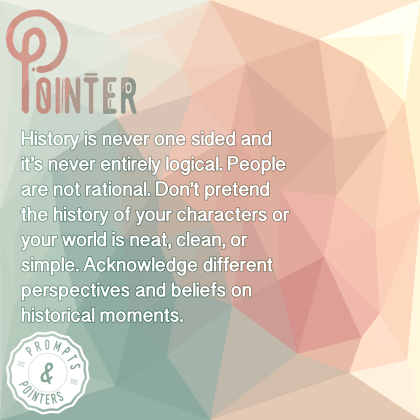
History is never one sided and it’s never entirely logical. People are not rational. Don’t pretend the history of your characters or your world is neat, clean, or simple. Acknowledge different perspectives and beliefs on historical moments.
History is never one sided and it’s never entirely logical. People are not rational. Don’t pretend the history of your characters or your world is neat, clean, or simple. Acknowledge different perspectives and beliefs on historical moments.










 AUTHOR | HISTORIAN | ARTIST