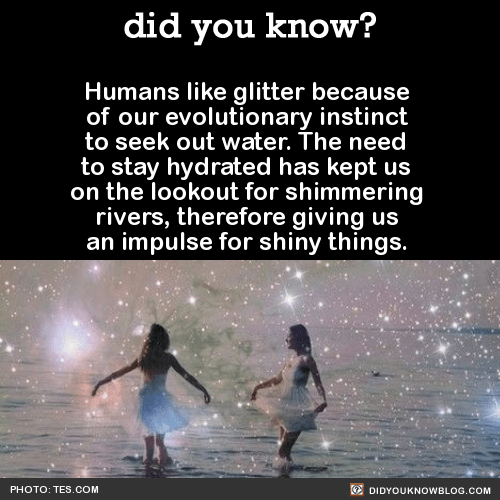
Humans like glitter because of our evolutionary instinct to seek out water. The need to stay hydrated has kept us on the lookout for shimmering rivers, therefore giving us an impulse for shiny things. Source
Humans like glitter because of our evolutionary instinct to seek out water. The need to stay hydrated has kept us on the lookout for shimmering rivers, therefore giving us an impulse for shiny things. Source
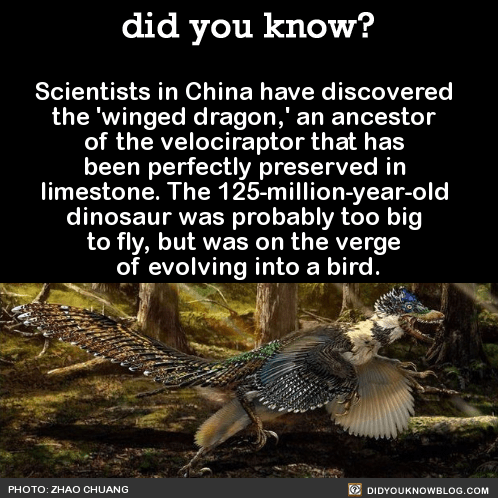
Lead researcher Dr Steve Brusatte said it was “the single most beautiful fossil I have had the privilege to work on.”
“ …It will blow some people’s minds to realise that those dinosaurs in the movies would have been even weirder, and I think even scarier – like big fluffy birds from hell.”
“So maybe [wings] did not evolve for flight – perhaps they evolved as a display structure, or to protect eggs in the nest. Or maybe this animal was starting to move around in the trees and was able to glide.”
Dr Bill Sellers from the University of Manchester added these details about the origin of birds. “It doesn’t look like [this dinosaur] could fly, although that needs more investigation. “However it does mean that we now know about a huge range of these early bird-like dinosaurs; some species are running around on the ground and some are experimenting with early flight.”
“[This] gives us a snapshot of what life was like at the earliest stages of bird evolution. China is the epicentre of palaeontology right now. There are [museum] storerooms full of new dinosaur fossils that have never been studied before. This is the most exciting time maybe in the history of palaeontology.”
Lead researcher Dr Steve Brusatte said it was “the single most beautiful fossil I have had the privilege to work on.”
“ …It will blow some people’s minds to realise that those dinosaurs in the movies would have been even weirder, and I think even scarier – like big fluffy birds from hell.”
“So maybe [wings] did not evolve for flight – perhaps they evolved as a display structure, or to protect eggs in the nest. Or maybe this animal was starting to move around in the trees and was able to glide.”
Dr Bill Sellers from the University of Manchester added these details about the origin of birds. “It doesn’t look like [this dinosaur] could fly, although that needs more investigation. “However it does mean that we now know about a huge range of these early bird-like dinosaurs; some species are running around on the ground and some are experimenting with early flight.”
“[This] gives us a snapshot of what life was like at the earliest stages of bird evolution. China is the epicentre of palaeontology right now. There are [museum] storerooms full of new dinosaur fossils that have never been studied before. This is the most exciting time maybe in the history of palaeontology.”
Getting published is an experience unlike any other, and
although it’s been a rollercoaster ride of awesomeness, there are some rules of
the game which I wish I’d known prior to signing on the dotted line.
1. It’s
OK to argue with your editor. Encouraged, even. Your editor has one job: to
make the story better. Naturally, the author wants this too, which means
disagreements are bound to arise. An editor who lets just anything slide isn’t
doing their job, but at the same time, the author should have major influence.
Arguing means both sides are passionate, and that’s awesome. Think of it as like a stellar
collision: when two stars are pulled into each other’s gravitational fields and
collide at sufficient speeds, their collective awesomeness coalesces. Out of
this exploding nebula of extra-terrestrial excellence, an even brighter, bigger
star emerges. Pretty cool, huh?
2. You’re
allowed to be embarrassed. It’s a natural reaction to people’s amazement. “You wrote a book?” friends and family
exclaim, delighted. You want to refute – less out of modesty than just sheer
awkwardness – but they’re having none of it. Everyone is super happy for you,
which is nice, of course, but sometimes, their happiness makes you want to curl
up under a rock somewhere. Writers are solitary creatures, after all. We dwell
in the shadows cast by the light of our computer screens, entertaining
ourselves with thoughts of strange and horrible things happening to the people
in our heads. (Note: no, we don’t need to be institutionalized.)
3. Marketing
is hard… and doesn’t necessarily work. I’m the sort of author who doesn’t
mind the odd cover reveal or book tour, but coordinating interviews and guest
spots is a mammoth task in itself. And there are no tangible rewards, either,
since it’s impossible to know the reasons behind readers purchasing your book.
Was it because they liked the cover? Or were they enchanted by the interview in
which you gushed about your Celine Dion obsession? Who knows. It’s all part of
building your brand, though, which is why I hired a publicist to organize the
release day blitz for UNTOUCHABLE.
4. Bad
reviews aren’t the end of the world. I suppose I can’t really talk. The
lowest review I’ve gotten is four stars, though I’m anticipating an end to the
streak any day now. Why? Every author – seriously, every single one – gets lacklustre reviews. It’s nothing to be ashamed
or upset about. As a matter of fact, I don’t mind bad reviews provided they’re
constructive and offer suggestions. As writers, we’re always improving our craft,
and reviews allow our most important critics – readers – to help us do just
that. Got a bad review and want to feel better about it? Just head over to
Goodreads, click on your favourite book and scroll down til you find the
inevitable one-star and two-star reviews. It just goes to show that it’s
impossible to please absolutely everyone. (Also, whatever you do, never respond to bad reviews. For that
matter, don’t even respond to wonderful ones. It’s unprofessional and kind of
stalkerish.)
5. It’s
OK to be dissatisfied. I used to think getting
an acceptance meant a publisher arriving in a helicopter, six-figure contract in
hand. Nowadays, I realise how crazy I was. Most writers dream of publication
their entire lives, and when it finally happens, it can be depressingly anti-climactic.
That’s fine. Just remember to be grateful for the little milestones – like getting
to see your cover for the first time. Or hearing the delighted squeals of
readers who received an ARC. Or even just noticing a spike in your Amazon
rankings. These are things that all authors get to experience, not just the Big
Six elite.
And don’t forget: at the end of the day, you have the privilege of calling yourself an author. Embrace it.





 AUTHOR | HISTORIAN | ARTIST