We had a visitor write an angry review about our historic house museum, giving us 2 stars, stating: “It blew, there were tons of chairs but I wasn’t allowed to sit on any of them. It’s great if you like going places where you aren’t allowed to touch anything. WOULD NOT RECOMMEND.“
Sorry you weren’t allowed to put your butt on enough of our stuff.
__________________
Editor: This made me think, “What factors actually go in to a 1 or 2 star museum review?” So I drank some whiskey and looked up some reviews of well-known museums on TripAdvisor and Yelp and then I felt the need to drink some more. Of course, everyone is entitled to their opinion and art is very subjective, so some of the low rates reviews I give a pass for personal preference, agree to disagree and all that. Some even felt justifiable, based on staff or communication failures (though those also need to be taken with a grain of salt). However, the reviews below made my eyes involuntarily roll and my hand involuntarily reach for a drink.
There’s probably tons more, but that’s when I fell asleep on my couch hugging a bottle of Jack Daniels like it was a teddy bear.
The museum I work at (also a Children’s Museum) got bad reviews for having too many exhibits and advertising geared toward children (and said reviewer claimed to have children of their own…) as well as a bad review from someone saying that our security was terrible because they didn’t control other people’s kids from getting in their kids’ way and that the reviewer wouldn’t be returning until we could guarantee that other visitors’ children would be civilized (though, don’t we all wish that they would be)…because we are obviously a day care and we should watch people’s kids for them…
ASTROLOGY is divination using celestial bodies: the sun, moon, planets, and stars.
CARTOMANCY is fortune telling using cards such as the Tarot.
CLAIRAUDIENCE is “clear hearing” of divinatory information. Parapsychologist generally regard as a form of extrasensory perception.
CLAIRVOYANCE is “clear seeing” of divinatory information. Parapsychologist generally regard as a form of extrasensory perception.
CRYSTALLOMANCY is divination through crystal gazing.
DOWSING or DIVINING RODS are methods of divination where a forked stick is used to locate water or precious minerals.
NUMEROLOGY is the numerical interpretation of numbers, dates, and the number value of letters.
OCULOMANCY is divination from a person’s eye.
PALMISTRYis the broad field of divination and interpretation of the lines and structure of the hand.
PRECOGNITION in an inner knowledge or sense of future events.
PSYCHOMETRY is the faculty of gaining impressions from a physical object and its history.
RADIESTHESIAis the general term for divination using a device such as a divining rod or pendulum. Other forms include “table tipping” which was practiced at the White House in the 19th century, the Ouija board, automatic writing (or superconscious writing), and scrying.
SCIOMANCY is divination using a spirit guide, a method generally employed by chanelers.
SCRYING is a general term for divination using a crystal, mirrors, bowls of water, ink, or flames to induce visions.
TASSEOGRAPHYis the reading of tea leaves that remain in a tea cup once the beverage has been drunk.
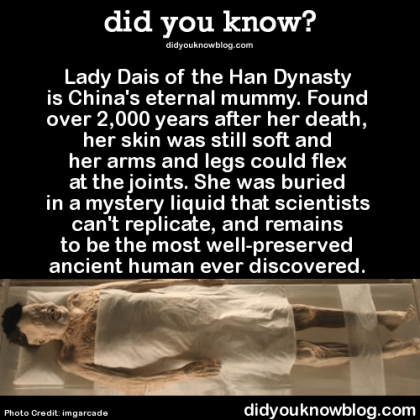
Lady Dais of the Han Dynasty is China’s eternal mummy. Found over 2,000 years after her death, her skin was still soft and her arms and legs could flex at the joints. She was buried in a mystery liquid that scientists can’t replicate, and remains to be the most well-preserved ancient human ever discovered. Source
One check box can’t sum up a person’s heritage and experience.
Our @smithsonianfolklife, which is dedicated to studying and preserving cultures, asked today’s Asian Americans how they describe themselves, about their family history, to explain their challenges and share their triumphs.























 AUTHOR | HISTORIAN | ARTIST