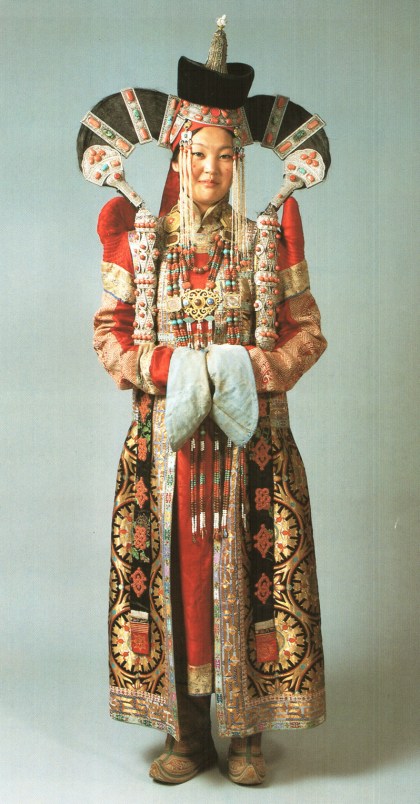
Married Woman’s Ensemble
Late 19th Century to Early 20th Century
Halh People, Mongolia

Married Woman’s Ensemble
Late 19th Century to Early 20th Century
Halh People, Mongolia

Cool sites: 911 Writer’s Block, an interactive development game for writers when they hit the wall.
Sometimes a character is born fully-formed. You know them as well as a member of your family and you don’t need to figure out what they think because they’re more than happy to tell you.
Other times, the character just sits on the page, lifeless and uncooperative. You…
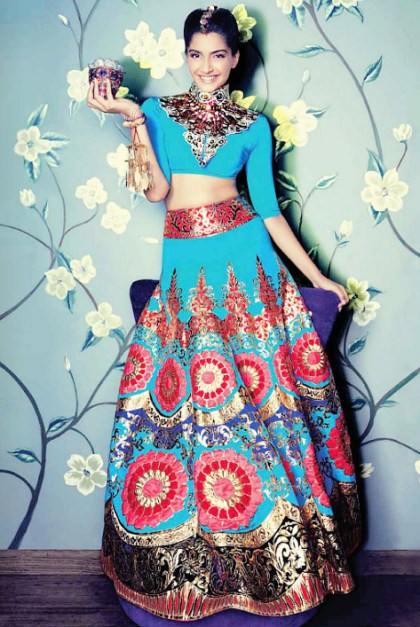
Manish Arora Lehenga, Blouse and Necklace, Judith Leiber Clutch, Zoya Bangle & Cuff
I swear, like clockwork, we get this question nearly every month. What is the secret to writing something different from me? There are no secrets, there is no guides, no quick lists of what all Korean-Americans are like (because no one works that way). Don’t treat characters like they’re some unfathomable other, because they’re not, they’re human beings like you and me and anyone else.
Why are you worried about writing a stereotypical caricature? Is it because that’s all you know? Change that. Consume media written by Korean-Americans, realize that being Korean-American will effect who he is just like your background effects who you are, and make sure your characters are human beings.
Worried about white-washing history? Read history. There’s lots of it out there, by Korean-Americans, and it’s easily accessible on the internet. Go to museums, check out books assigned in Asian American studies. They exist, you’re just not looking for them.
Stop being afraid of writing POC characters because “you might get it wrong.” Do type the questions you just asked me into google, and start from there. Do realize that your characters are human, share the same interests and motivations as everyone else, and should be treated as such. .
Another proud Korean-American here. I agree with the person that said to go talk to Korean-Americans and to pick up some Korean-American literature (and to add Big Bang in if it’s contemporary.) 🙂 But I want to comment here that as Americans first, we will all have different experiences just like every other person in the U.S. For example, I can’t speak Korean and my involvement in the culture is basically only my knowledge of how to make a few dishes. My parents were both raised in the South and I was born in the Midwest, so by most standards, I was raised in white culture and most tumblr race advocates would probably consider me to be white-washed because of how I was brought up.
However, this doesn’t give an excuse to automatically make the character white-washed for your own convenience. Find out some good info, ponder on it, and see where the character takes you. Remember, the characters can make the story, and as long as you don’t put anything blatantly racist in there, most Korean-Americans shouldn’t have an issue because we are all different.




Chinese knotting (TC:中國結; SC:中国结;pinyin: Zhōngguó jié) is a decorative handicraft art that began in the Tang and Song Dynasty (960-1279 AD) in China. It is used as a decoration for rooms, fans, folding screens, musical instruments etc. and an accessory for clothing (mostly go with jewelries like jades).
Chinese knots are usually lanyard type arrangements where two cords enter from the top of the knot and two cords leave from the bottom. The knots are usually double-layered and symmetrical.
Some of the earliest evidence of knotting have been preserved on bronze vessels of the Warring States period (481–221 BCE), Buddhist carvings of the Northern Dynasties period (317–581) and on silk paintings during the Western Han period. Further references to knotting have also been found in literature, poetry and the private letters. In the 18th century, one novel that talked extensively about the art was “Dream of the Red Chamber”. It is mentioned that the knots were used as gifts for relatives and friends, also as a token of love depending on different types of knots.
do you have any links to good tutorials?
I don’t have any video.. But I have these pics showing how to tie 18 types of knots. They might be helpful to you.





 AUTHOR | HISTORIAN | ARTIST