Hi, thanks for the question! I covered the basic types of men’s hanfu here and here, so in this post I’ll describe the basic types of women’s hanfu. Resources on identifying different types of hanfu can be found in my reference tag.
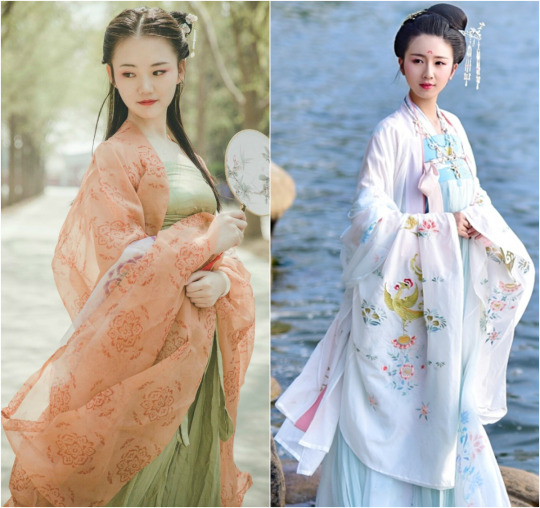
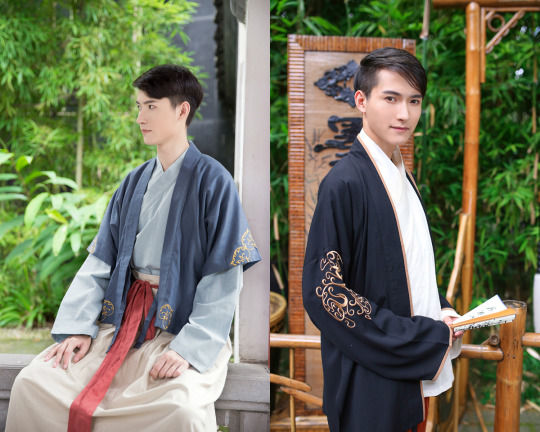
– Ruqun/襦裙 – the most basic type of hanfu consisting of a top and a wrap-around skirt. The top is called “ru/襦” and the skirt is called “qun/ 裙”, hence “ruqun”. Sleeves can be narrow or wide. Generally speaking, people divide ruqun into two types based on the height of the skirt: “Qiyao Ruqun/ 齐腰襦裙” (waist-high ruqun) and “Qixiong Ruqun/ 齐胸襦裙” (chest-high ruqun).
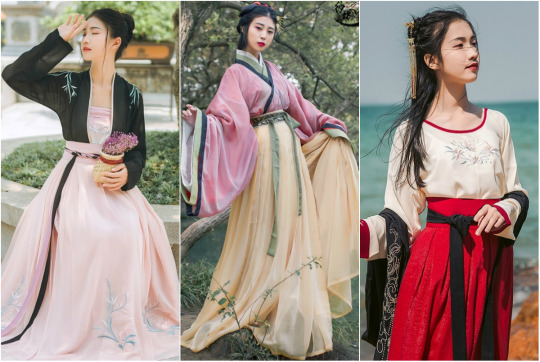
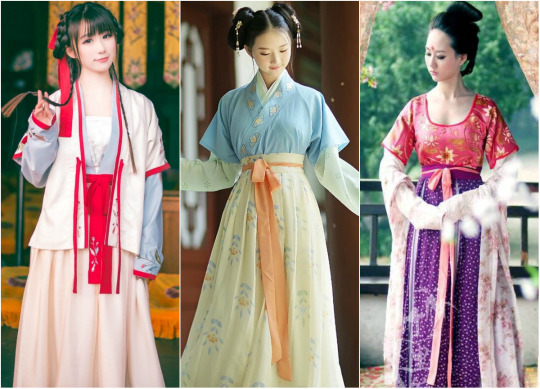
“Qiyao Ruqun” is the kind of ruqun in which the waistband is on the waist. Both men and women can wear it. For women, the top’s collar can be parallel (left), crossed (middle), or u-shaped (right). Men’s ruqun are cross-collared only.
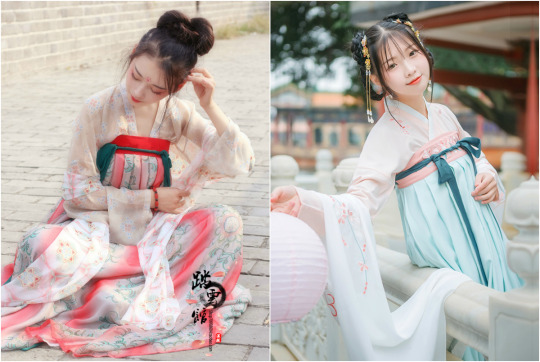
“Qixiong Ruqun”, on the other hand, has its waistband above the chest. The top’s collar can be parallel (left) or crossed (right). It’s only worn by women.
As seen in the photos above, ruqun is often accessorized with a long scarf called Pibo/披帛. Originally used to protect against wind and cold air, pibo gradually became an important feature of hanfu.
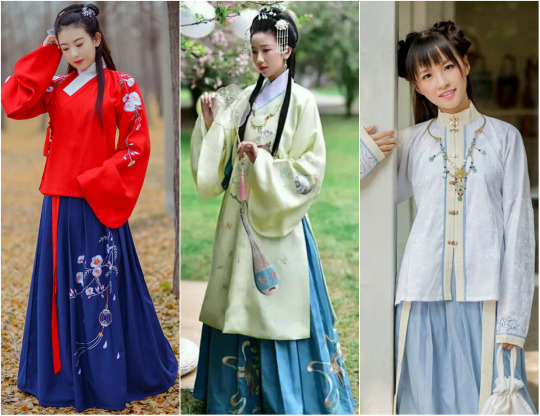
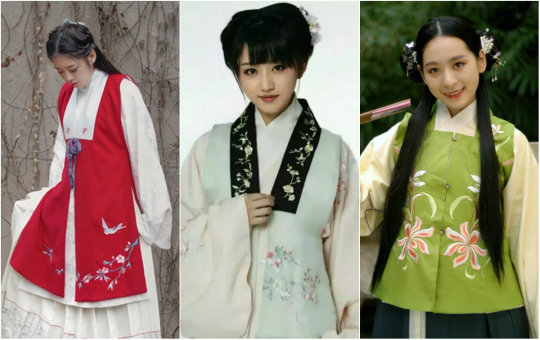
– Aoqun/袄裙 – a type of ruqun that became fashionable during the Ming Dynasty. It consists of a double-layered top called “ao/袄“ and a waist-high skirt (”qun”), hence “aoqun”. Unlike the “standard” ruqun that has the top tucked inside the skirt, the aoqun’s top is worn untucked, above the skirt. There are two types of “ao” – “short ao” and “long ao”. The “short ao” (left, right) reaches the waist, while the “long ao” (middle) covers the knees. Ao collars can be crossed (left, middle) or upright (right). Only worn by women.
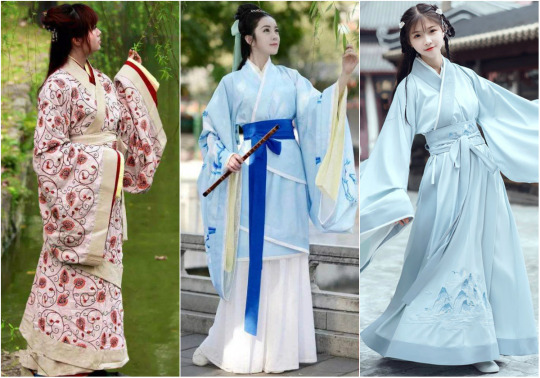
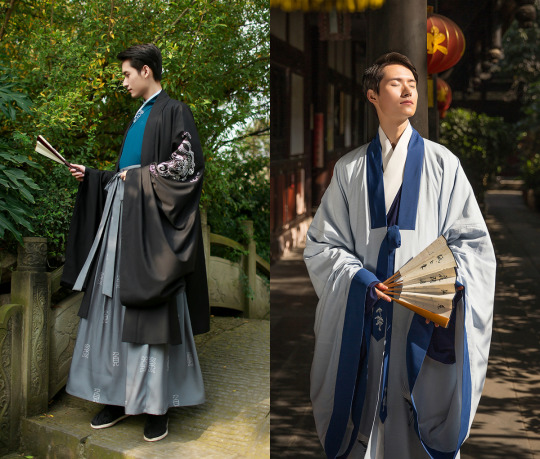
– Unlike ruqun and aoqun which are made of separate top and bottom pieces, the Shenyi/深衣 style of hanfu consists of one-piece robes that wrap around the body once or several times. Quju/曲裾 (curved-hem robe) and Zhiju/直裾(straight-hem robe) are two types of shenyi. The quju (left, middle) is a robe in which the bottom hem of the left lapel spirals its way up to the waist of the wearer. Modern quju can come in a shortened version (middle) that reveals the skirt worn underneath. In contrast to the quju, the bottom hem of the zhiju (right) circles around levelly, creating a straight line. Quju and Zhiju are worn by both men and women.
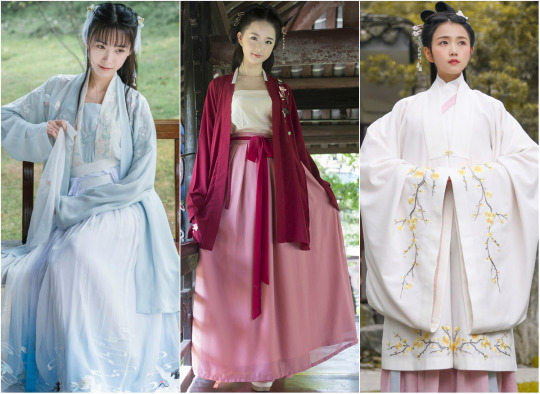
– Beizi/褙子 – a parallel-collar “jacket” withside slits beginning at the armpit or at the waist. It can be secured at the front either with ties or a metal button. Extremely versatile, it can be long or short, have narrow or wide sleeves, and is worn by both men and women. During the Song Dynasty, it was popular to wear narrow-sleeved beizi over a chest undergarment and skirt/pants (middle). Another name for Ming Dynasty-style beizi is Pifeng/披风 (right). Pifeng collars can also be upright (not shown).
– Banbi/半臂 – a half-sleeve jacket worn by both men and women. It comes in various lengths and is usually worn over ruqun. Its collar can be parallel (left), crossed (middle), or u-shaped (right). When paired with ruqun, it can be worn tucked inside the skirt as well as over the skirt (untucked).
– Bijia/比甲 – a sleeveless jacket, usually worn over aoqun, that comes in various lengths and styles.
– Daxiushan/大袖衫 – large-sleeve robe commonly paired with ruqun. As its name indicates, its main feature is its broad sleeves. The length is at least 78 inches, and the width exceeds 40 inches. The material is generally thin and light, because it was originally created for wear in the summer.
Of course this doesn’t cover everything, but it describes the basic hanfu styles that appear most often on this blog. Hope this helps!
Makeup test for my #cosplay tomorrow. I find it funny that my first #selfie on my account isn’t a glamour shot by any means. XD #writersofinstagram #makeuptest
Hey everyone! Just to give you a heads up, there will be no WAW or FourGodsFriday this week because of my writing schedule and other life events. Segments will be back to normal next week.
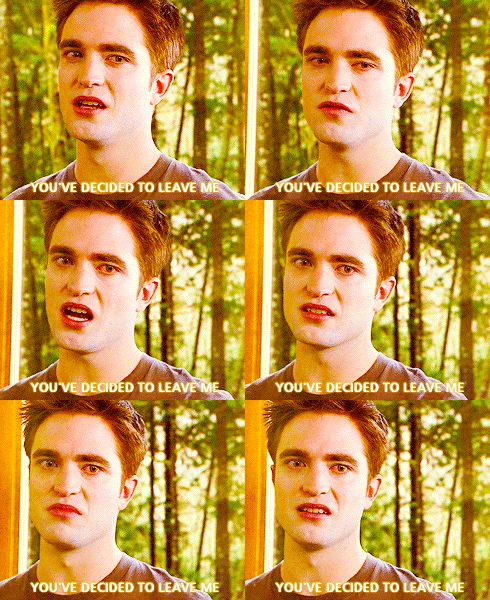
He’s gorgeous. Brooding. Bejeweled with countless sequins. He stresses over and over again that he and the female protagonist have a “connection,” are “soulmates,” or something else that you’d generally expect to hear from that one creepy kid who used to stare at you in class. Similarly, in true creep fashion, he uses their supposed connection as an excuse to blatantly stalk her, and is narratively treated as nothing short of a romantic in spite of it because he’s attractive (and sparkly) enough to pull it off.
Examples:
In the Twilight Saga, Edward is canonically over one hundred years old, making it extra creepy that he’s A) hanging around a high school for no particular reason, and B) dating a seventeen-year-old girl. He uses derogatory terms about past lovers, attempts suicide when Bella tries to break up with him, and shows up at her home uninvited to watch her sleep. Moreover, his systematic isolation of Bella from her friends and family is all-too reminiscent of real life abusive dynamics.
Try to avoid a blatant power imbalance. Edward is stressed to be older, stronger, more experienced, and more intelligent than Bella. Sometimes power imbalances are unavoidable due to species differences, but this can be countermanded by giving the human love interest qualities that make them valuable in other ways.
Overall, if you’re attempting to portray a healthy relationship, try to base it on an equal exchange of power and mutual respect.
2. The Christian Grey (i.e. the glorified rapist)
How to spot him:
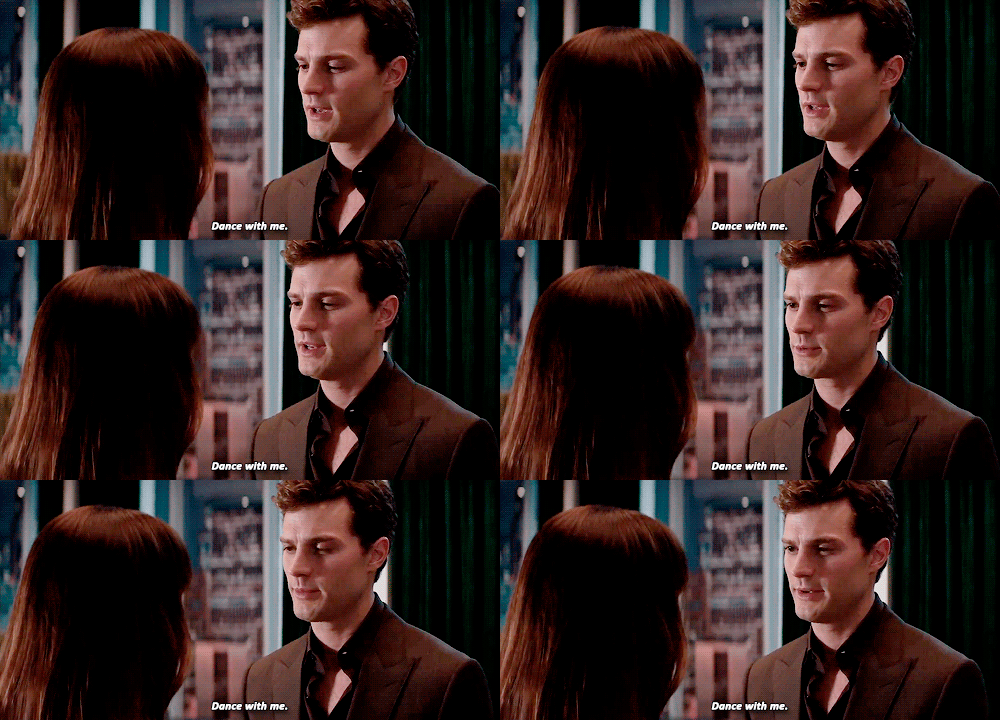
When I first found out that the 50 Shades of Grey franchise was originally Twilight fanfiction, I initially (incorrectly) presumed it to be a joke. After I’d come to terms with the fact that it was not, my next thought was that it made perfect sense, because Christian is literally Edward Junior on steroids: the same abusive brand of stalker who gets off on a blatant power imbalance, with the added unpleasantries of excessive wealth and bad BDSM etiquette. Oh, yeah. And he’s a rapist.
Examples:
Christian disregards Ana’s request for a condom, stating “her body belongs to him,” threatens punishment when she refutes his attempts to discretely grope her in public, and at one point, ignores her safe word. Throughout the book, Ana is pressured into sex she feels uncomfortable with.
How to avoid him:
If you’re going to write about BDSM, actually study BDSM etiquette.
Healthy BDSM relationships are forged on mutual trust and a consensual, mutually beneficial exchange of power. Even if you are writing about BDSM, if you intend to write about a healthy relationship, be sure to base it off of these values.
Just because a character is dominant doesn’t mean they need to be emotionally callous; Christian completely neglects Ana’s emotional needs, such as her aftercare (i.e. the period of tenderness recommended after BDSM sessions to compensate for the emotional and physically taxing task of surrendering one’s power.)
In short, don’t use kink as a means of excusing emotionally unhealthy and abusive dynamics.
3. The Ross Geller (i.e. the entitled “nice guy”)
How to spot him:
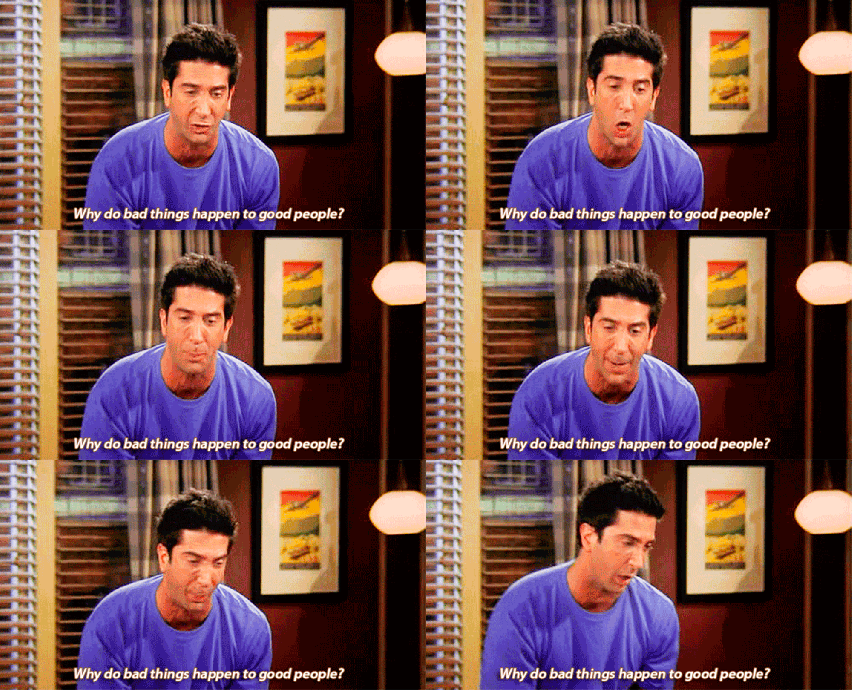
He thinks his hot female friends (and only the hot ones, mind you) are owed to him because he’s “nice,” romantic, and intelligent. However, upon closer scrutiny he really isn’t a particularly nice guy (i.e. he bullied his sister Monica and benefits from enjoys her emotionally abusive parents’ favoritism), is self-centered, and consistently places his needs ahead of her own.
Examples:
The minute Rachel begins to find self-fulfillment in her career, Ross becomes jealous and hounds her at work, accuses her of “not having enough time for (him),” and generally tries to make her feel guilty for being successful and having priorities other than him.
How to avoid him:
Again, I cannot stress this enough: mutual respect. This is literally the foundation of all successful relationships, fictitious or otherwise.
Have your male characters support their significant other’s decisions and allow them to be happy for their success.
Your male character’s significant other is allowed to do things that don’t necessarily involve him. Make sure he understands that.
Intelligence in and of itself does not make a character a better person than his fellows, and intelligence does not have to equate the superiority with which Ross appears to associate himself.
Just look to the healthier couples Friends churned out in its time: Monica and Chandler, for example, love and respect one another’s goals, and are no the less interesting and hilarious because of it.
4. The Sheldon Cooper (i.e. the annoying autism stereotype)
How to spot him:
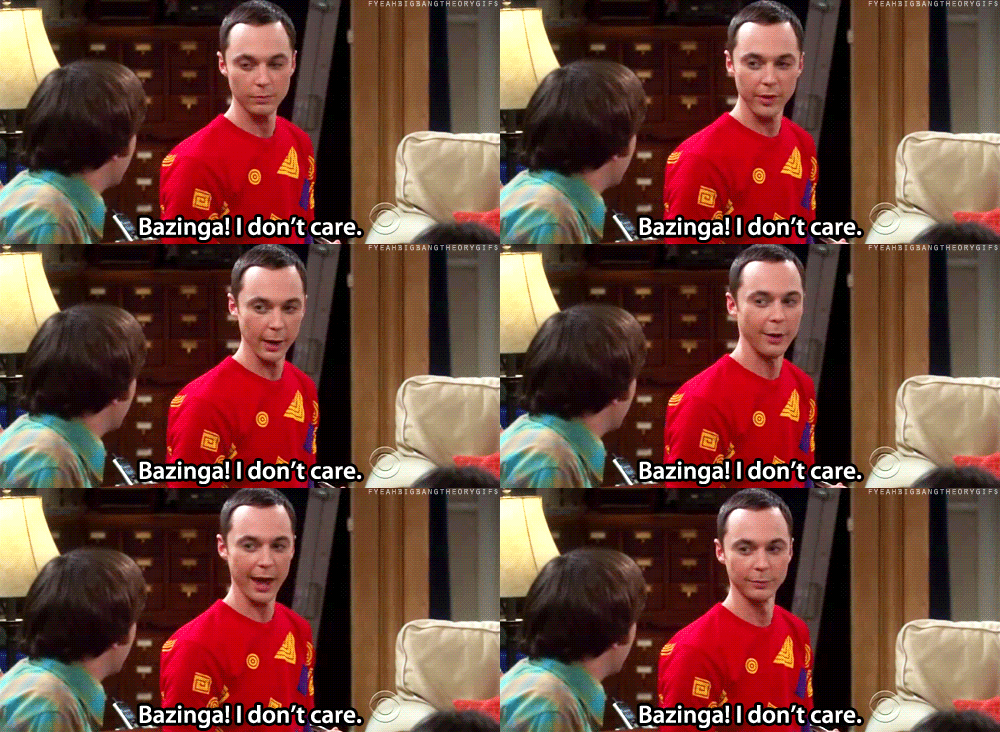
He’s a bloated paragon of autism stereotypes. He’s got zero regard for the feelings of his friends, considers himself superior to everyone, and is incapable of talking about anything but his own interests. As someone who’s on the spectrum myself, he’s basically my personal pet peeve.
Examples:
“His spot” on the sofa, his need to knock three times before speaking to the person on the other side of the door, etc. These are stereotypical and inaccurate portrayals of some autistic people’s comfort in routine.
How to avoid him:
Research symptoms of Asperger’s in adults (and for god’s sake, stay away from Autism Speaks.) Similarly, try and learn from actually people with Asperger’s, as anti-autism, “cure”-based sentiment tends to run high in allistic academia.
Study the mannerisms of famous people who may have been on the spectrum, such as Albert Einstein, Allan Turing, Leonardo da Vinci, and Sherlock Holmes’s inspiration, Joseph Bell.
If you’re not ready to depict an autistic character, I’m going to say wait. It’s okay to admit to ignorance, and it’s okay to wait to do more research before depicting a certain subgroup.
Try to avoid inserting autistic symptoms into characters to use as comedic fodder.
Asperger’s coded (and confirmed, by creators and cast) characters like Temperance “Bones” Brennan (Bones) and Spencer Reid (Criminal Minds) have their stereotypical moments, but they’re still successfully presented as lovable, intelligent, and productive characters; look to them to see better representation of intelligent, autistic characters in mainstream television.
5. The John Winchester (i.e. the abusive parent with a redemption arc)
How to spot him:
The John Winchester is a textually abusive or otherwise toxic parent who damages his children’s lives for his own purposes, inflicts emotional or physical harm, and is shown or mentioned to be violent, controlling, and/or neglectful. However, his redeeming/sympathetic qualities or otherwise heroic actions lead him to be narratively treated as a benevolent character and “good” parent.
Examples:
In Supernatural, John leaves his boys for weeks on end in motel rooms, sometimes over important holidays (and keep in mind that this was in the 80s and 90s, when child sexual abuse was at an all-time high.) He often places his eldest son as the soul caregiver of his other child, despite the fact that he was a child too at the time, and left them both alone with loaded firearms. He also uses unfairly harsh punishments, such as leaving his young son alone at a boy’s home for an entire summer because he stole food for himself and his brother. His son literally, unironically realized he was being possessed by a demonic entity when it said it was proud of him.
How to avoid him:
Educate yourself on the different definitions of abuse (emotional, verbal, physical, etc.) and what qualifies as each. Psychology Today is a great resource for this (they have some rudimentary definitions here: https://www.psychologytoday.com/conditions/child-abuse.)
Feel free to endow abusive parents with sympathetic qualities (in fact, please do; 100% evil characters tend to be campy, boring, and/or unintentionally hilarious) but be aware that no sympathetic qualities negate or justify child abuse.
Please, for the love of God, don’t use the “he was doing his best” excuse as a resolution. Many abusive parents legitimately are doing their best, and many abused children are acutely aware of this. It really doesn’t provide much comfort.
Remember that abused children frequently refuse to turn on their parents, often defending them long into their adulthood. The child’s forgiveness does not equate the parent’s redemption.
Similarly, I’d personally recommend staying away from the “I can finally forgive him” trope as well; it’s done to death, and often frustrating to real-life survivors.
Before the Meninsits™ come for me about this, I am going to be writing a list of female character archetypes as well, and then make lists of positive attributes to include in male and female characters, respectively, to provide a counterpoint. I might also make a part two of this post for all the other characters I hate, because I fear it would get too long.
In the meantime, there will be essays like this published at least once every other week, so be sure to follow my blog and stay tuned for future writing advice and observations!










 AUTHOR | HISTORIAN | ARTIST