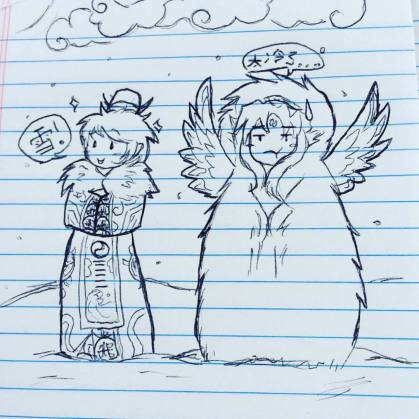
It’s snowing off and on today, and I thought of Gen. His favorite season is winter and he finds the snow magical and lovely. Fengge, on the other hand, hates winter and will only go out in the snow if he’s in a bajillion layers of silk and fur. #thefourgods #characterdoodles #xuanwu #fenghuang #winterwonderland #babyitscoldoutside
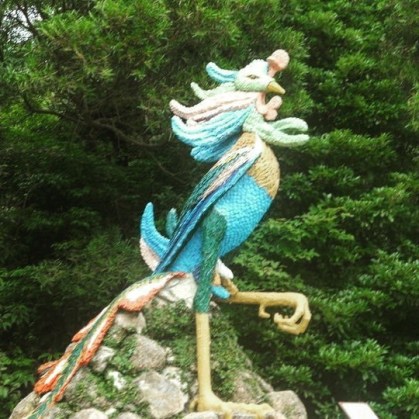
It’s #fourgodsfriday and this week I’ll be talking about the Fenghuang (凤凰). I took this photo about 6 years ago at Phoenix Mountain in Hong Kong. In Chinese mythology, the term Phoenix and Fenghuang are used interchangeably to describe the same being, but this can be confusing as the Greek Phoenix and the Fenghuang only share similarities in being firebirds. The Fenghuang is an immortal bird that acts as a messenger and upholder of justice, but also serves as a god of music and the arts since it is said to have the most beautiful voice out of all creatures. Throughout history, the Fenghuang is also paired with the Dragon to be a symbol and representation of the Empress. Like Fengge in TFG, the Fenghuang is also sometimes shown as arrogant and proud like peacocks, but only when it is fulfilling virtue and reigning as “the king of birds.” While known for being gentle, they have been shown being fierce hunters of serpents and omens of the ending or reinstatement of the Mandate of Heaven. For more info on the Fenghuang of the TFG world, you can visit my blog. #thefourgods #fenghuang #chinesemythology #hongkong #writerlife
For this Four Gods Friday, I’m going to go in depth on the function of the Si Ling Organization. This concept, as with most in the TFG universe, are taken straight from Chinese mythology, but I have taken some creative liberties with the symbols. Let’s get to it!
In ancient Chinese culture when people were still trying to understand the cosmos, the heavens were divided into four different quadrants: north, south, east, and west. These quadrants were ruled by four sacred beasts: The Black Tortoise for the north, the Vermillion Bird for the south, the Azure Dragon for the east, and the White Tiger for the west. Though this concept existed in Chinese culture for thousands of years, these four beasts were not solidified in these records until the Han Dynasty, which is when TFG begins. Each beast had a number of stars in their quadrants that they ruled over. Historical records speculate that astronomers and astrologers of the times used these four beasts as a guide to make predictions about natural events or signs from Heaven. Others say that these beast themselves ruled over the fate of the Chinese empire. This latter telling is the version I use in TFG. Now, most records say that these four symbols are called Si Xiang (四象) in Chinese, but I use Si Ling in TFG because that signifies that they are the Four Sacred Beasts (which includes the Qilin) rather than simply four astrological symbols, even though that is their main function.
Let’s talk about these creatures themselves, starting with the Tortoise. In Chinese myth, the Tortoise has agency over water and is represented by the color black (the color of water). Its season is winter and the Tortoise, along with the serpent usually coiled around it, is seen as a symbol of longevity and wisdom. The Tortoise, along with the other three gods has seven ‘mansions’ (stars used to determine lunar position) in its arsenal, and reigns over stars in the Sagittarius, Aquarius, Capricorn, and Pegasus constellations. In TFG, I combine this symbol with the myth of the god Xuanwu, who is depicted as a warrior god of the north and is accompanied by a tortoise and a serpent at all times. Some records say they were his cursed intestines and stomach that he ripped out of his own body when he tried to repent for his past sins, others state that they were formed out of his mortality when he ascended and he subdued them and recruited them as his generals.
Next up is the Vermillion Bird or sometimes misnamed as the Phoenix of the south. The Vermillion Bird is often said to be a type of Fenghuang, but the Vermillion Bird is not a Fenghuang, but merely a different type of mythical bird. The character of que (雀) in Zhuque, actually determines that it is a sparrow-like bird, not a chimeric entity like the Fenghuang is. In TFG, Zhuque is merely a position title a Fenghuang can acquire, and is equivalent to a position of a prince/princess or duke/duchess in the Fenghuang rankings. The Vermillion Bird has agency over fire and is represented by the color red. Its season is summer and is a symbol of nobility and respect, as the Bird is said to be selective about what it eats and where it likes to perch (though the same is said for the Fenghuang.) However, unlike the other three gods of the Si Ling, the Vermillion Bird is usually not considered a god or worshipped outside of the four symbol context and is not often used in other imagery, hence the common confusion about whether the creature is a Fenghuang, as their appearances are often similar. The seven mansions of the Vermillion Bird are mainly found in the constellation Hydra.
The Dragon is probably the most signature creature of Chinese mythology, but the Dragon of the Si Ling is a jack of all trades. This Dragon has agency over earth (not water, as is sometimes mistaken because of the dragon’s azure color) and is represented by the color green/blue. The qing (青) in Qinglong describes a rich teal, but can also be used to describe a deep shade of green. Its season is spring and it is also usually considered as the Dragon King of the Eastern Sea, due to its sovereignty over the east and its azure color to match. Because it is considered one of the Four Dragon Kings, this guy is considered regal and powerful and is worshipped outside of the four symbols context, especially by seafarers or fisherman who may be trekking out into the Dragon’s waters. This Dragon was also the one to appear on the royal flag of the Qing dynasty (1644-1911). The seven mansions of the Azure Dragon are located mainly in the constellation of Scorpio, but it also has mansions in Virgo and Sagittarius.
And finally, we arrive at the White Tiger. Now, some of you who have beta read or have been following these segments are probably wondering where the Qilin comes in. The Qilin was the original creature associated with the west, however, the Tiger later replaced it due to it representing the quadrant better in astronomical records. The Qilin/Tiger in this context have agency over metal (I interpret these abilities as weaponry and magical abilities including lightning) and are represented by the color white. Their season is autumn and both symbols were heavily revered by the ruling class. The Qilin and Tiger overlap in the sense that they are both obsessed with virtue and justice, and they are both associated with the king. The Qilin appears when a virtuous king is born or dies (see more about Qilin and Chonglin here) and the Tiger is seen as a mythical being due to its white color (which symbolizes longevity in this case) and because it has the character for “king” (王) written on its forehead in its stripes. The Tiger, unlike the somewhat pacifistic Qilin, is seen as a god of war and militaristic values, however, both beasts offer protection from evil spirits. The seven mansions ruled over by the Qilin/Tiger are stars positioned mainly in the constellations of Orion and Taurus, but also includes stars in Aries and Andromeda.
That’s all for this week! I hope you enjoyed it and as always, I’ll be open for questions and comments. Until next time!
Hey all! So I’ve decided to change the format for #FourGodsFriday. From this week on, I will be giving you a look into the characters, mythology, or the world of The Four Gods, while also remaining open for questions. This week, I’m going to give you a more in-depth look into the Fenghuang tribes that appear throughout the series. Here we go!
There are four tribes of Fenghuang:
发明 Faming “Light Issuing” (East)– These Fenghuang are usually the upper tier of the Fenghuang clans. They consider themselves the most proper of all four tribes and deem the other three as simple and even savage. Though they have very high views of themselves, they are not as politically savvy as some of the other tribes. Their powers are fire-based but they are very skilled in wind and sound magic. Their plumage contains more blues and greens than other Fenghuang. When in a humanoid form, these Fenghuang have hair colors in the brown and auburn spectrum and usually having brown or amber eyes. Skin color can vary, but these Fenghuang are on the paler side. Their clothing and collective culture is the closest to Han Chinese culture out of all four tribes. They also have the most contact with humans.
烧明 Shaoming “Light Burning” (South)– The Fenghuang in the southern tribe while not the classiest of clans, usually hold all the positions of power, much to the eastern tribe’s chagrin. The Shaoming have reputations for being scandalous, having fiery tempers, and extremely knowledgable of Heavenly politics. These Fenghuang have fire-based magic and also have skills in sound magics. Wind magic is not their forte, however, there are rumors floating around the Heavens that the Shaoming have crossbred with Long considering some have been able to master water-based magics. Their plumage exclusively features warm tones, mainly reds and oranges, however some can have violet colors in their feathers. In humanoid forms, the Shaoming Fenghuang have brighter hair colors ranging from browns to reds, and their eye colors can range from black to amber to violet. The Shaoming generally have the darkest skin colors out of all four tribes. Their culture and clothing resembles the Miao of southern China, but since this is the biggest tribe, they have been known to acclimate to other cultures of southern China such as the Tujia, Zhuang, and Yi cultures. In TFG, this is the tribe Fengge and his family hail from.
速霜 Sushuang "Severe Frost" (West)- The Sushuang are the most spiritual out of the four tribes. Despite being the tribe closest to Heaven, they are the least involved in politics and value spirituality and philosophy over their ranks. They are the most wind affiliated out of the four tribes when it comes to their magic, but they also have the strongest sound magic out of all the tribes. Their plumage has more yellows and whites than the other tribes, and they are more accustomed to higher altitudes and extreme temperatures. In their humanoid forms, the Sushuang can have the most extreme features, with hair colors featuring blacks, browns, whites, and even blues. They eye colors can also range from black to blue, while most have a hazel-like eye color. Their skin, like the Shaoming, can be quite dark, but they can also be extremely pale. Their culture and clothing would be closest to Tibetan culture.
逾長 Yuzhang “Exceeding Growth” (North)- The Yuzhang are the most removed out of all the Fenghuang tribes and prefer to stay out of everyone’s business. Next to the Sushuang, they are the least involved in politics, but when present, are the most level-headed. Their magic is also wind affiliated, but are not skilled in sound or fire magics. Their plumage has more black than other tribes, and they are the quietest flyers out of all Fenghuang. In their humanoid forms, they are closest to resembling humans with hair colors in the blacks and browns and eye colors within the same spectrum. Their skin is the palest out of the four tribes. Their collective culture closely resembles the Manchu and Mongolian cultures.
In all Fenghuang tribes, their ruling classes are called Jinghuo 精火, and all young are called Yue 鸑. The two highest positions in the entire collective tribe are Zhuque 朱雀, which is an office of the Si Ling 四靈, and the Fenghuang Tianwang 鳳凰天王, which serves as chief to all four tribes.
A bit of a #beforeandafter and #throwbackthursday, on the left is a drawing of Fengge I did in 2011, when I was beginning to take #thefourgods seriously as a piece of writing. On the right is a drawing of Fengge I did this morning in pencil. His design and wardrobe have changed to mirror his affiliation with southern China and to display more of the Fenghuang culture shown in the book. He’s also no longer the protagonist, but plays a crucial role in the story. #characterdesign #writerslife #fenghuang
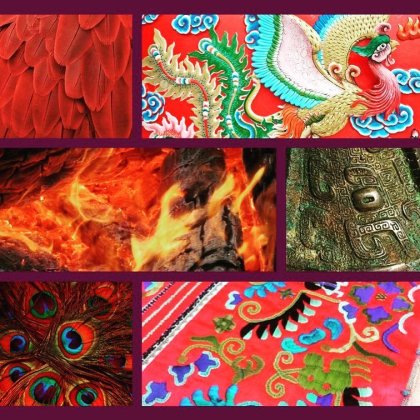
Next moodboard for #thefourgods is Fengge, the Fenghuang of the group and southern guardian in the Si Ling. #amediting #amwriting #moodboard #zhuque #fenghuang
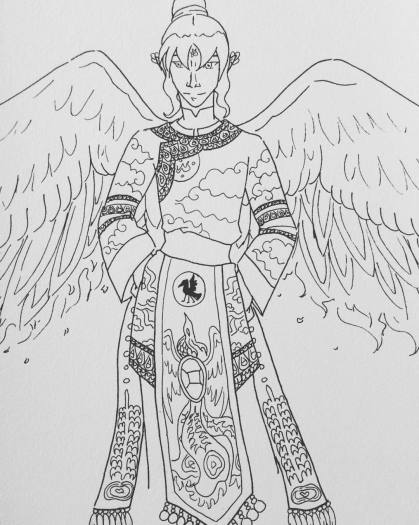
Huojin doodles. Huojin is a side character in #thefourgods and is Fengge’s older brother and chief of the Fenghuang. Because he and Fengge come from the southern tribe of Fenghuang, their clothing is inspired by the Miao people. #characterdesign #fenghuang



 AUTHOR | HISTORIAN | ARTIST