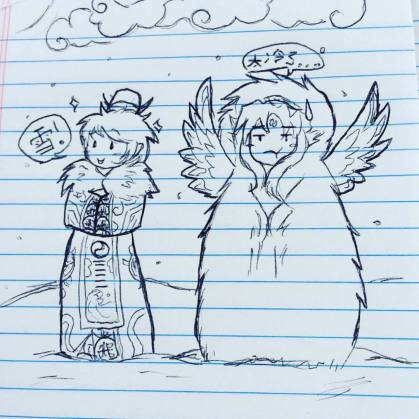
It’s snowing off and on today, and I thought of Gen. His favorite season is winter and he finds the snow magical and lovely. Fengge, on the other hand, hates winter and will only go out in the snow if he’s in a bajillion layers of silk and fur. #thefourgods #characterdoodles #xuanwu #fenghuang #winterwonderland #babyitscoldoutside
I’m back with another #FourGodsFriday! And I’m sorry about last week, I completely spaced doing a segment, but we’re back on track this week. I know I said I was going to cover the Qilin tribes, and I most likely will next week, but this time, I want to talk about the god Xuanwu.
A few FGF ago, I went into detail about the role of each god in traditional Chinese myth and astrology, but I didn’t really go into depth about the god Xuanwu (a different Xuanwu than in the Si Ling Order) and Gen’s role as a representation of that god.
Xuanwu’s origins tie him to the Tortoise-Snake of the Si Ling and also pin him as guardian of the North, just like his animalistic namesake in the Si Ling. Originally a Daoist deity, his origins are somewhat of a conundrum as some pin his origins with the Xuanwu of the Si Ling who was later anthropomorphized into a more human form, some say he was already somewhat divine when he achieved his full immortality, which there are two main versions of this story.
In original myth, Xuanwu was said to be a prince of a wise king, and his mother conceived him after she had a dream that she swallowed the sun. Troubled by the suffering of humankind that he witnessed growing up, he left to study the Dao on Mt. Wudang and ascended to immortality after 42 years. To this day, Xuanwu is an extremely important god for those who practice Tai Chi, Kung Fu, and most other martial arts in China. Once he ascended, it is rumored that the gods had to replace his human body with a divine one, but when they threw out his digestive system to replace it, his stomach and intestines transformed into a tortoise and a serpent.
The second version is less happy and much more gruesome. Another lesser told story is that Xuanwu was born a butcher, but was a horrific and cruel person who had no morals and no care for other living things. One day, he was out walking and a woman going into labor begged for his help. He stopped to help the woman, who promptly transformed into the goddess of mercy, Guanyin. Guanyin told Xuanwu to repent for his sins, and realizing the error of his ways, Xuanwu ripped his stomach and intestines out with his own two hands and washed them in the river. The river turned black with evil, and when he ascended, his two organs morphed into demons that he later was sent to subdue. In some tellings, he killed them triumphantly, in others, they changed into a tortoise and a serpent who repented and offered to serve him for the rest of their lives as his generals.
Gen’s story was loosely based off of the first and most popular telling of the myth, and in TFG, the story is told to imply that Gen is Xuanwu. But Gen is a character all his own whose story is only loosely based on the mythology, but he achieved immortality through studying the Dao, but his requirements were different. He ascended much like the original god did, but his escapades with the other three gods are unique to his character. I can’t reveal much more because of spoilers. 😛
Next week I’ll cover the Qilin tribes! Stay tuned!
For this Four Gods Friday, I’m going to go in depth on the function of the Si Ling Organization. This concept, as with most in the TFG universe, are taken straight from Chinese mythology, but I have taken some creative liberties with the symbols. Let’s get to it!
In ancient Chinese culture when people were still trying to understand the cosmos, the heavens were divided into four different quadrants: north, south, east, and west. These quadrants were ruled by four sacred beasts: The Black Tortoise for the north, the Vermillion Bird for the south, the Azure Dragon for the east, and the White Tiger for the west. Though this concept existed in Chinese culture for thousands of years, these four beasts were not solidified in these records until the Han Dynasty, which is when TFG begins. Each beast had a number of stars in their quadrants that they ruled over. Historical records speculate that astronomers and astrologers of the times used these four beasts as a guide to make predictions about natural events or signs from Heaven. Others say that these beast themselves ruled over the fate of the Chinese empire. This latter telling is the version I use in TFG. Now, most records say that these four symbols are called Si Xiang (四象) in Chinese, but I use Si Ling in TFG because that signifies that they are the Four Sacred Beasts (which includes the Qilin) rather than simply four astrological symbols, even though that is their main function.
Let’s talk about these creatures themselves, starting with the Tortoise. In Chinese myth, the Tortoise has agency over water and is represented by the color black (the color of water). Its season is winter and the Tortoise, along with the serpent usually coiled around it, is seen as a symbol of longevity and wisdom. The Tortoise, along with the other three gods has seven ‘mansions’ (stars used to determine lunar position) in its arsenal, and reigns over stars in the Sagittarius, Aquarius, Capricorn, and Pegasus constellations. In TFG, I combine this symbol with the myth of the god Xuanwu, who is depicted as a warrior god of the north and is accompanied by a tortoise and a serpent at all times. Some records say they were his cursed intestines and stomach that he ripped out of his own body when he tried to repent for his past sins, others state that they were formed out of his mortality when he ascended and he subdued them and recruited them as his generals.
Next up is the Vermillion Bird or sometimes misnamed as the Phoenix of the south. The Vermillion Bird is often said to be a type of Fenghuang, but the Vermillion Bird is not a Fenghuang, but merely a different type of mythical bird. The character of que (雀) in Zhuque, actually determines that it is a sparrow-like bird, not a chimeric entity like the Fenghuang is. In TFG, Zhuque is merely a position title a Fenghuang can acquire, and is equivalent to a position of a prince/princess or duke/duchess in the Fenghuang rankings. The Vermillion Bird has agency over fire and is represented by the color red. Its season is summer and is a symbol of nobility and respect, as the Bird is said to be selective about what it eats and where it likes to perch (though the same is said for the Fenghuang.) However, unlike the other three gods of the Si Ling, the Vermillion Bird is usually not considered a god or worshipped outside of the four symbol context and is not often used in other imagery, hence the common confusion about whether the creature is a Fenghuang, as their appearances are often similar. The seven mansions of the Vermillion Bird are mainly found in the constellation Hydra.
The Dragon is probably the most signature creature of Chinese mythology, but the Dragon of the Si Ling is a jack of all trades. This Dragon has agency over earth (not water, as is sometimes mistaken because of the dragon’s azure color) and is represented by the color green/blue. The qing (青) in Qinglong describes a rich teal, but can also be used to describe a deep shade of green. Its season is spring and it is also usually considered as the Dragon King of the Eastern Sea, due to its sovereignty over the east and its azure color to match. Because it is considered one of the Four Dragon Kings, this guy is considered regal and powerful and is worshipped outside of the four symbols context, especially by seafarers or fisherman who may be trekking out into the Dragon’s waters. This Dragon was also the one to appear on the royal flag of the Qing dynasty (1644-1911). The seven mansions of the Azure Dragon are located mainly in the constellation of Scorpio, but it also has mansions in Virgo and Sagittarius.
And finally, we arrive at the White Tiger. Now, some of you who have beta read or have been following these segments are probably wondering where the Qilin comes in. The Qilin was the original creature associated with the west, however, the Tiger later replaced it due to it representing the quadrant better in astronomical records. The Qilin/Tiger in this context have agency over metal (I interpret these abilities as weaponry and magical abilities including lightning) and are represented by the color white. Their season is autumn and both symbols were heavily revered by the ruling class. The Qilin and Tiger overlap in the sense that they are both obsessed with virtue and justice, and they are both associated with the king. The Qilin appears when a virtuous king is born or dies (see more about Qilin and Chonglin here) and the Tiger is seen as a mythical being due to its white color (which symbolizes longevity in this case) and because it has the character for “king” (王) written on its forehead in its stripes. The Tiger, unlike the somewhat pacifistic Qilin, is seen as a god of war and militaristic values, however, both beasts offer protection from evil spirits. The seven mansions ruled over by the Qilin/Tiger are stars positioned mainly in the constellations of Orion and Taurus, but also includes stars in Aries and Andromeda.
That’s all for this week! I hope you enjoyed it and as always, I’ll be open for questions and comments. Until next time!
More Gen doodles! I wanted to draw him in a more dynamic pose to show his warrior tendencies. I decided to dress him in a deel since he’s the guardian of the North and the god he represents is the patron god of Mongolia. #thefourgods #characterdesign #writerslife #doodles #xuanwu
A more detailed drawing of Gen. I based his clothing off of a lot of traditional garb seen on Xuanwu. #thefourgods #characterdesign #xuanwu
I decided to start doing moodboards for #thefourgods to promote my characters to my readers. First up is Gen, hero of Book 1. #amediting #amwriting #moodboard #xuanwu
Gen doodles. Finally, the protagonist of #thefourgods Book 1. XP A glimpse of him in his princely garb and how his hair looks when not pulled back in a topknot. #characterdesign #writerslife #xuanwu
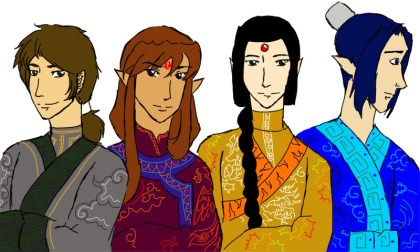
Some of you may recognize these guys. 🙂 Character art time! These are quick on-the-spot sketches of my four gods, nothing fancy. From left to right: Gen (根), the human/immortal protagonist of Book 1, Fengge (鳳歌) the Fenghuang of the group, Chonglin (翀麟) the wise Qilin, and Longwei (龍偉) the Dragon and leader of the four. Hopefully, I can post more detailed drawings of these guys in the future but for now, I’m going to plug away at my word count!
Fun fact: I originally designed these four back in my high school algebra class, about 10 years ago. Their story was originally going to be a comic, but as I got older and more into writing, I decided to try and turn it into a book series.



 AUTHOR | HISTORIAN | ARTIST